Utilisation : Ce produit est destiné uniquement à la recherche.
Toutes les informations sur les produits présentes sur ce site sont fournies à titre éducatif uniquement. Toute forme d’introduction dans le corps humain ou animal est strictement interdite par la loi. Ce produit doit être manipulé uniquement par des professionnels agréés et qualifiés. Il ne s’agit pas d’un médicament, d’un aliment ou d’un cosmétique et il ne doit pas être présenté, utilisé ou étiqueté comme tel.
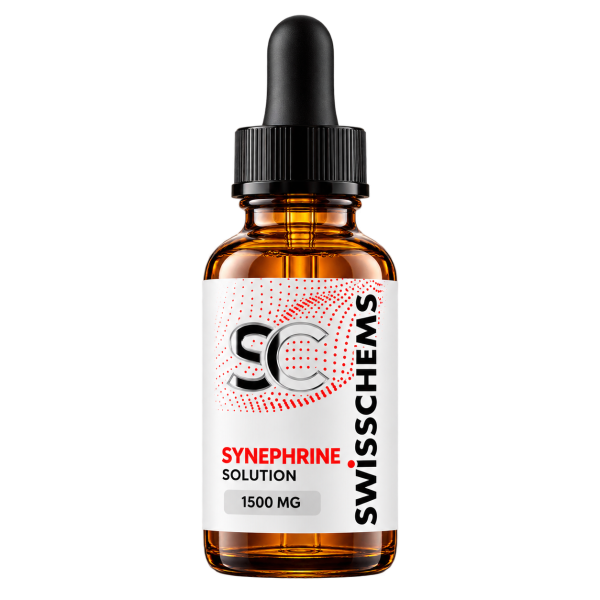
Synephrine – Solution, 1500 mg (50 mg/1 ml)
Pendant notre changement d’emballage, vous pouvez recevoir des produits avec l’ancienne ou la nouvelle étiquette. La formulation, la pureté et la qualité restent exactement les mêmes, selon nos standards.
- Carte de crédit
- Virement bancaire (SEPA instantané)
- Virement bancaire (ACH)
- Wise
- Revolut
- Zelle
- Remitly
- Western Union
- Chime
- Autres
-25% sur tout – jusqu’au 31 octobre
25% sur les prix habituels, en remplacement des autres soldes. Cumulable uniquement avec la remise crypto.
Expédition le jour même pour les commandes aux États-Unis passées avant 12 h EST.
Voir la politique de livraison →Chaque lot est testé pour sa pureté, sa puissance et sa qualité.
Voir les résultats d’analyse →Synephrine is a naturally occurring protoalkaloid structurally related to phenylethanolamines, known for its interaction with adrenergic receptors. It primarily binds to β-adrenergic and α-adrenergic receptor subtypes, modulating catecholamine signaling pathways in research applications.
This compound undergoes hepatic metabolism via monoamine oxidase (MAO) and sulfation pathways, with primary clearance occurring through renal excretion. The liquid formulation (50mg/ml) enhances solubility and stability, ensuring precise measurement and controlled administration in experimental settings.
- High Purity – 99% Purity Guaranteed
- Independently Lab Tested
- Research Grade Quality
- For Laboratory Research Use Only
3D Molecular Structure
Drag to rotate · scroll to zoom| Chemical Formula | C9H13NO2 |
|---|---|
| Synonyms | Oxedrine, Parasympatol, Sympaethamine, Sympatol, Analeptin, Simpatol, Synephrin, Synthenate, Sympathol, p-Oxedrine |
| Molar Mass | 167.21 g/mol |
| CAS Number | 94-07-5 |
| PubChem CID | 7172 |
| Total Compound Content | 1500mg |
| Shelf Life | 36 months |
Every batch is independently lab tested for identity, purity and potency. View our lab testing program →
What is the basis for synephrine's reported beta-3 adrenergic receptor selectivity in research models?
Receptor subtype-selective binding and functional assays — typically comparing synephrine's potency at beta-1, beta-2, and beta-3 adrenergic receptor subtypes using cAMP accumulation or radioligand displacement methods — are used to characterise its relative selectivity profile. This research is conducted in the context of broader structure-activity work on phenylethanolamine compounds, comparing synephrine's substitution pattern to other adrenergic agonists with different subtype selectivity to map which structural features drive beta-3 preference.
How does solution format support dosing precision compared to solid powder preparations in synephrine research?
Solution format at a defined concentration (50 mg/ml) allows researchers to administer precise volumetric doses without requiring on-site weighing and dissolution, reducing a source of dosing variability in protocols requiring repeated or time-sensitive administration. This format is particularly useful in rodent pharmacokinetic studies and in vitro dose-response work where rapid, accurate dilution series preparation is required.
What structural relationship does synephrine have to other phenylethanolamine adrenergic compounds studied in receptor research?
Synephrine shares the core phenylethanolamine scaffold with related compounds in this structural class, differing in the specific pattern and position of hydroxyl and methyl substituents on the aromatic ring and amine nitrogen. These structural differences are the basis for comparative structure-activity relationship studies examining how substitution pattern influences adrenergic receptor subtype selectivity and binding affinity across the phenylethanolamine compound series.