Utilisation : Ce produit est destiné uniquement à la recherche.
Toutes les informations sur les produits présentes sur ce site sont fournies à titre éducatif uniquement. Toute forme d’introduction dans le corps humain ou animal est strictement interdite par la loi. Ce produit doit être manipulé uniquement par des professionnels agréés et qualifiés. Il ne s’agit pas d’un médicament, d’un aliment ou d’un cosmétique et il ne doit pas être présenté, utilisé ou étiqueté comme tel.
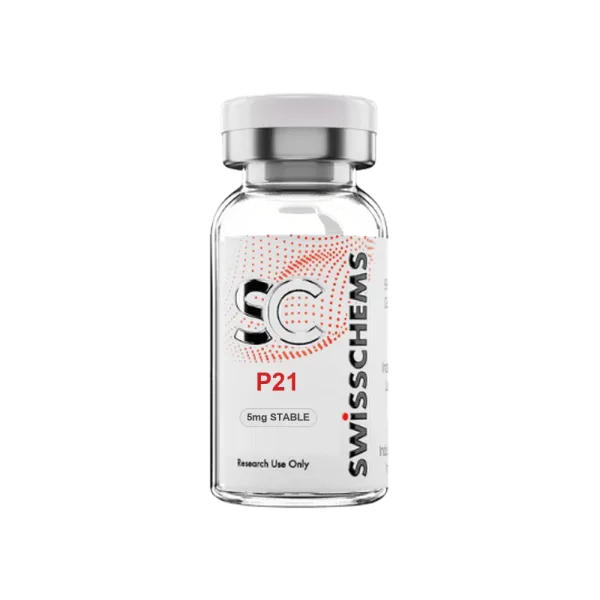
P21 5mg
Pendant notre changement d’emballage, vous pouvez recevoir des produits avec l’ancienne ou la nouvelle étiquette. La formulation, la pureté et la qualité restent exactement les mêmes, selon nos standards.
- Carte de crédit
- Virement bancaire (SEPA instantané)
- Virement bancaire (ACH)
- Wise
- Revolut
- Zelle
- Remitly
- Western Union
- Chime
- Autres
-25% sur tout – jusqu’au 31 octobre
25% sur les prix habituels, en remplacement des autres soldes. Cumulable uniquement avec la remise crypto.
Expédition le jour même pour les commandes aux États-Unis passées avant 12 h EST.
Voir la politique de livraison →Chaque lot est testé pour sa pureté, sa puissance et sa qualité.
Voir les résultats d’analyse →P21 (Peptide 021) is a synthetic tetrapeptide derived from a fragment of ciliary neurotrophic factor (CNTF), developed for experimental studies on neurotrophic signalling.
Research interest centers on its proposed role in supporting neurogenesis and synaptic function research models, with structural modifications studied for their effect on compound stability and blood-brain barrier permeability characteristics. Research applications include CNTF pathway studies, neurotrophic peptide structure-activity research, and synaptic function investigation.
- High Purity – 99% Purity Guaranteed
- Independently Lab Tested
- Research Grade Quality
- For Laboratory Research Use Only
3D Molecular Structure
Drag to rotate · scroll to zoom| Chemical Formula | C27H42N6O8 |
|---|---|
| Synonyms | P021, Ac-dggl-adamatanylglycine-NH2, P-21 nootropic peptide |
| Molar Mass | 578.7 g/mol |
| CAS Number | 1246751-68-7 |
| PubChem CID | 56599151 |
| Total Compound Content | 5mg per vial |
| Shelf Life | 36 months |
Every batch is independently lab tested for identity, purity and potency. View our lab testing program →
What is the relationship between P21 and the parent CNTF protein in neurotrophic signalling research?
P21 is a synthetic peptide derived from a fragment of ciliary neurotrophic factor (CNTF), a signalling protein involved in neuronal growth, differentiation, and survival pathways. Research with P21 focuses on determining whether this smaller peptide fragment can reproduce selected downstream signalling effects associated with CNTF while providing a simplified tool for studying neurotrophic pathway regulation.
What structural modifications were incorporated into P21's design?
P21 incorporates modifications to the native CNTF-derived fragment that have been investigated for their effects on peptide stability and tissue distribution. Comparative structure-activity studies examine how these modifications influence degradation resistance, signalling activity, and overall experimental utility relative to unmodified peptide fragments.
What experimental endpoints are used to study P21's proposed effects on neurogenesis and synaptic function?
Research commonly utilizes neural cell culture systems to evaluate neurogenesis-associated biomarkers, neuronal differentiation markers, synaptic protein expression, and signalling pathways related to neuronal plasticity. Additional endpoints may include measurements of neurite outgrowth, cellular maturation, and electrophysiological markers of synaptic activity to characterize effects on neural network function.