Uso del producto: Este producto está destinado exclusivamente a la investigación.
Toda la información de los productos de este sitio web tiene fines exclusivamente educativos. Cualquier forma de introducción en el cuerpo de personas o animales está estrictamente prohibida por la ley. Este producto solo debe ser manipulado por profesionales autorizados y cualificados. No es un medicamento, alimento ni cosmético y no debe etiquetarse, utilizarse ni presentarse como tal.
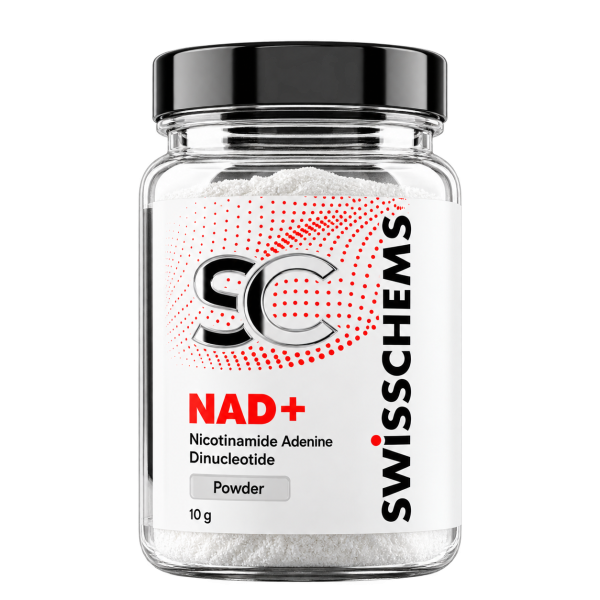
NAD+ (Nicotinamide Adenine Dinucleotide) – Powder, 10 grams
Durante el cambio de envase, puedes recibir productos con la etiqueta anterior o con la nueva. La formulación, la pureza y la calidad siguen siendo exactamente las mismas, según nuestros estándares.
- Tarjeta de crédito
- Transferencia bancaria (SEPA inmediata)
- Transferencia bancaria (ACH)
- Wise
- Revolut
- Zelle
- Remitly
- Western Union
- Chime
- Otros
-25% en todo – hasta el 31 de octubre
25% sobre los precios habituales, en sustitución de otras ofertas. Acumulable solo con el descuento crypto.
Envío en el día para pedidos en EE. UU. realizados antes de las 12:00 EST.
Ver la política de envíos →Devoluciones sin complicaciones en 30 días para productos sin abrir.
Ver la política de devoluciones →Cada lote se analiza para comprobar su pureza, potencia y calidad.
Ver resultados de laboratorio →NAD+ powder (10 g) provides the oxidised form of the universal cellular redox cofactor in bulk unencapsulated format for laboratory applications requiring solution preparation, defined concentration assays, or high-volume research protocols.
As with the injectable format, NAD+ serves as electron carrier in catabolic pathways and as obligate co-substrate for sirtuins (SIRT1–7), PARPs, and CD38/CD157. The powder format enables precise molar concentration preparation for in vitro biochemical assays.
- High Purity – 99% Purity Guaranteed
- Independently Lab Tested
- Research Grade Quality
- For Laboratory Research Use Only
3D Molecular Structure
Drag to rotate · scroll to zoom| Chemical Formula | C21H27N7O14P2 |
|---|---|
| Synonyms | NAD+, β-NAD+, Coenzyme I, Diphosphopyridine nucleotide (oxidised form) |
| Molar Mass | 663.43 g/mol |
| CAS Number | 53-84-9 |
| PubChem CID | 5892 |
| Total Compound Content | 10 g powder |
| Shelf Life | 24 months |
Every batch is independently lab tested for identity, purity and potency. View our lab testing program →
What is the aqueous stability of NAD+ in solution, and how should stock solutions be stored?
NAD+ undergoes gradual hydrolysis in aqueous solution, particularly under conditions that promote cleavage of the nucleotide structure. For experimental applications requiring maximum stability, solutions are typically prepared fresh or stored under conditions that minimize degradation.
Lyophilized NAD+ powder exhibits substantially greater stability than aqueous solutions and is generally maintained in sealed, moisture-protected conditions to preserve compound integrity. Researchers conducting enzymatic or analytical studies should account for potential degradation when preparing and storing NAD+ solutions.
How is the powder format used in NAD+-dependent enzyme assays?
The powder format enables preparation of defined NAD+ concentrations for biochemical and enzymatic investigations involving NAD+-dependent reaction systems. Experimental studies frequently utilize NAD+ as a substrate or cofactor in analyses of sirtuin enzymology, PARP-associated reactions, CD38-mediated pathways, redox chemistry, and cofactor-dependent catalytic mechanisms.
The ability to prepare assay-specific concentrations makes the powder format particularly useful for enzyme kinetics, concentration-response experiments, and mechanistic studies of NAD+-utilizing systems.
What is the advantage of the powder format for research applications?
The powder format provides flexibility for preparation of custom concentrations and incorporation into a wide range of biochemical, analytical, and in vitro experimental systems. It is particularly useful for studies requiring precise control of NAD+ concentration, assay-specific buffer conditions, enzyme kinetic analysis, redox chemistry investigations, and cofactor-dependent reaction studies.
These characteristics make the powder format a valuable option for research programs involving NAD+-dependent molecular and enzymatic processes.