Uso del producto: Este producto está destinado exclusivamente a la investigación.
Toda la información de los productos de este sitio web tiene fines exclusivamente educativos. Cualquier forma de introducción en el cuerpo de personas o animales está estrictamente prohibida por la ley. Este producto solo debe ser manipulado por profesionales autorizados y cualificados. No es un medicamento, alimento ni cosmético y no debe etiquetarse, utilizarse ni presentarse como tal.
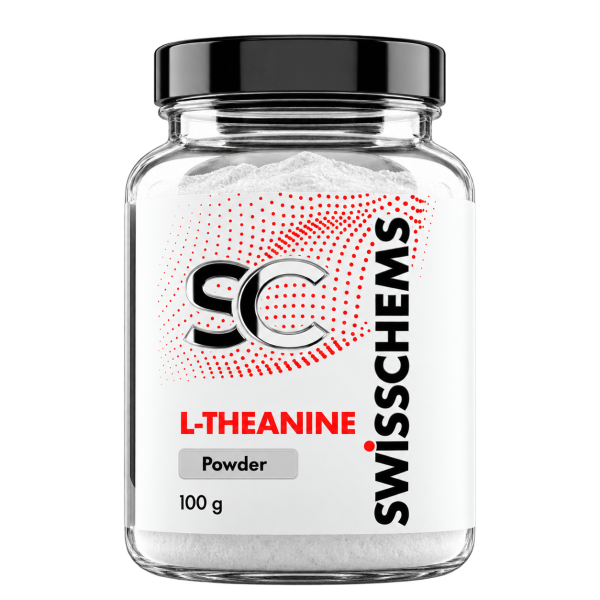
L-Theanine – Powder, 100 grams
Durante el cambio de envase, puedes recibir productos con la etiqueta anterior o con la nueva. La formulación, la pureza y la calidad siguen siendo exactamente las mismas, según nuestros estándares.
- Tarjeta de crédito
- Transferencia bancaria (SEPA inmediata)
- Transferencia bancaria (ACH)
- Wise
- Revolut
- Zelle
- Remitly
- Western Union
- Chime
- Otros
-25% en todo – hasta el 31 de octubre
25% sobre los precios habituales, en sustitución de otras ofertas. Acumulable solo con el descuento crypto.
Envío en el día para pedidos en EE. UU. realizados antes de las 12:00 EST.
Ver la política de envíos →Devoluciones sin complicaciones en 30 días para productos sin abrir.
Ver la política de devoluciones →Cada lote se analiza para comprobar su pureza, potencia y calidad.
Ver resultados de laboratorio →L-Theanine (γ-glutamylethylamide) is a naturally occurring non-protein amino acid investigated for its effects on glutamatergic, GABAergic, and monoaminergic signaling pathways. Experimental studies have demonstrated interactions with glutamate receptor systems, including NMDA and AMPA receptor-associated signaling mechanisms, as well as modulation of glutamate transporter activity.
Research has also examined its influence on GABA-related neurotransmission, intracellular signaling cascades, and neurotransmitter regulatory networks.
Its well-characterized activity profile makes L-Theanine a valuable research tool for investigations of glutamatergic signaling, receptor pharmacology, neurotransmitter modulation, electrophysiological activity, signal transduction mechanisms, and comparative amino acid neuropharmacology.
- High Purity – 99% Purity Guaranteed
- Independently Lab Tested
- Research Grade Quality
- For Laboratory Research Use Only
3D Molecular Structure
Drag to rotate · scroll to zoom| Chemical Formula | C7H14N2O3 |
|---|---|
| Synonyms | γ-Glutamylethylamide, L-γ-Glutamylethylamide, Suntheanine |
| Molar Mass | 174.20 g/mol |
| CAS Number | 3081-61-6 |
| PubChem CID | 439378 |
| Total Compound Content | 100 g powder |
| Shelf Life | 36 months |
Every batch is independently lab tested for identity, purity and potency. View our lab testing program →
How does L-theanine modulate glutamatergic signaling despite structural similarity to glutamate?
L-theanine (γ-glutamylethylamide) is structurally related to glutamate, but its ethylamide substitution alters its interactions with glutamate receptor systems and transport mechanisms. Experimental investigations have demonstrated activity at NMDA receptor-associated signaling pathways, where L-theanine functions differently from glutamate despite structural similarity.
Studies have also reported modulation of AMPA receptor-associated processes and interactions with excitatory amino acid transporters (EAATs), making L-theanine a useful research tool for examining receptor-ligand specificity, glutamatergic signaling regulation, and amino acid structure-activity relationships.
What is the basis for using L-theanine in electrophysiological research?
L-theanine has been extensively investigated in studies examining electrophysiological activity patterns and neurotransmitter-associated signaling networks. Experimental research has reported effects on oscillatory neural activity, glutamatergic signaling, GABA-associated pathways, and monoaminergic neurotransmitter systems.
These characteristics have made L-theanine a valuable tool for investigations of electrophysiological regulation, neurotransmitter network dynamics, receptor-transporter interactions, and signal integration across multiple neurotransmitter systems.
What solvent systems are commonly used for L-theanine in in vitro research applications?
L-theanine is highly water-soluble and is typically prepared in aqueous buffers, phosphate-buffered saline (PBS), or assay-specific media for biochemical and cell-based experiments.
Its favorable aqueous solubility facilitates preparation of defined-concentration stock solutions for receptor pharmacology studies, transporter investigations, concentration-response experiments, and other in vitro applications. The compound's stability and solubility characteristics make it particularly suitable for high-throughput experimental workflows and analytical research programs.