Verwendung: Dieses Produkt ist ausschließlich für Forschungszwecke bestimmt.
Alle Produktinformationen auf dieser Website dienen ausschließlich Bildungszwecken. Jede Form der Einbringung in den Körper von Menschen oder Tieren ist gesetzlich streng verboten. Dieses Produkt darf nur von zugelassenen und qualifizierten Fachleuten gehandhabt werden. Es ist kein Arzneimittel, Lebensmittel oder Kosmetikum und darf nicht als solches gekennzeichnet, verwendet oder falsch etikettiert werden.
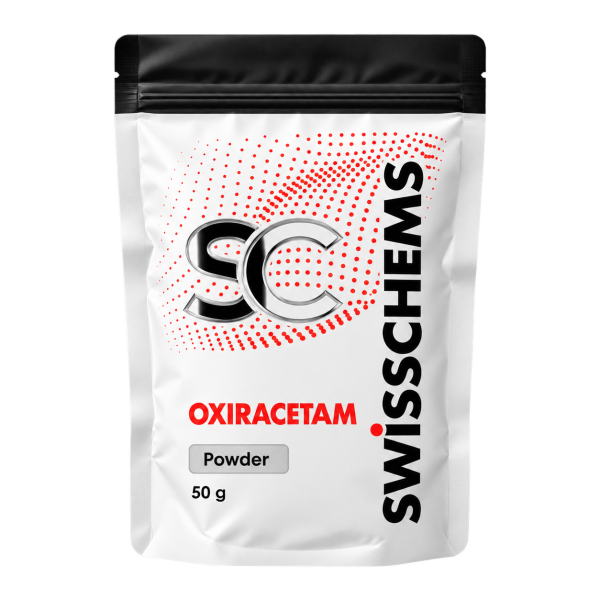
Oxiracetam – Powder, 50 grams
Während der Umstellung unserer Verpackung erhalten Sie möglicherweise Produkte mit dem bisherigen oder dem neuen Etikett. Formulierung, Reinheit und Qualität bleiben nach unseren Standards genau gleich.
- Kreditkarte
- Banküberweisung (SEPA Echtzeit)
- Banküberweisung (ACH)
- Wise
- Revolut
- Zelle
- Remitly
- Western Union
- Chime
- Andere
-25% auf alles – bis 31. Oktober
25% auf reguläre Preise statt anderer Angebote. Nur mit dem Krypto-Zahlungsrabatt kombinierbar.
Jede Charge wird auf Reinheit, Wirksamkeit und Qualität geprüft.
Laborergebnisse ansehen →Oxiracetam is a hydroxylated pyrrolidinone derivative within the racetam structural class, distinguished from piracetam by a 4-hydroxy substitution on the pyrrolidinone ring. Research interest centers on its proposed effects on glutamatergic AMPA receptor signalling and cholinergic pathway modulation in neuronal models.
Research applications include racetam structure-activity relationship studies, AMPA receptor pharmacology, and comparative pyrrolidinone-class compound research.
- High Purity – 99% Purity Guaranteed
- Independently Lab Tested
- Research Grade Quality
- For Laboratory Research Use Only
3D Molecular Structure
Drag to rotate · scroll to zoom| Chemical Formula | C6H10N2O3 |
|---|---|
| Synonyms | oxiracetam 62613-82-5, 2-(4-hydroxy-2-oxopyrrolidin-1-yl)acetamide, 4-Hydroxy-2-oxopyrrolidine-N-acetamide, ISF 2522 |
| Molar Mass | 158.16 g/mol |
| CAS Number | 62613-82-5 |
| PubChem CID | 4626 |
| Total Compound Content | 50 grams |
| Shelf Life | 36 months |
Every batch is independently lab tested for identity, purity and potency. View our lab testing program →
How does oxiracetam's structural modification relative to piracetam relate to its proposed mechanism of action?
Oxiracetam differs from piracetam by a hydroxyl group at the 4-position of the shared pyrrolidinone ring.
This structural modification is studied for its influence on receptor-binding affinity and pharmacokinetic properties relative to the parent compound, within structure-activity relationship research mapping how substitutions on the racetam core scaffold alter target engagement at glutamatergic and cholinergic systems.
Comparative binding and functional assays against piracetam and other racetam-family compounds are the standard approach for characterising this relationship.
What electrophysiological methods are used to study oxiracetam's effects on AMPA receptor signaling?
Patch-clamp electrophysiology in cultured neurons or brain slice preparations is the standard method for characterising compound effects on AMPA receptor-mediated excitatory postsynaptic currents (EPSCs), allowing researchers to quantify changes in current amplitude, kinetics, or desensitization properties following oxiracetam exposure. These functional electrophysiological readouts are typically paired with receptor-binding assays to distinguish direct receptor modulation from indirect effects on presynaptic glutamate release.
What is the research rationale for studying oxiracetam's combined effects on cholinergic and glutamatergic systems?
Because oxiracetam has been investigated for activity at both glutamatergic AMPA receptors and cholinergic high-affinity choline uptake, it serves as a research tool for studying potential crosstalk or convergent downstream effects between these two neurotransmitter systems on cognitive-relevant cellular endpoints (such as long-term potentiation models). Researchers isolating which pathway drives a given experimental outcome typically use selective antagonists for one system (e.g. an AMPA receptor antagonist) while measuring oxiracetam's effects on the other, to determine pathway dependence.