Uso del prodotto: Questo prodotto è destinato esclusivamente alla ricerca.
Tutte le informazioni sui prodotti presenti su questo sito hanno scopo esclusivamente educativo. Qualsiasi forma di introduzione nel corpo di esseri umani o animali è severamente vietata dalla legge. Questo prodotto deve essere maneggiato solo da professionisti abilitati e qualificati. Non è un farmaco, un alimento o un cosmetico e non deve essere etichettato, utilizzato o presentato come tale.
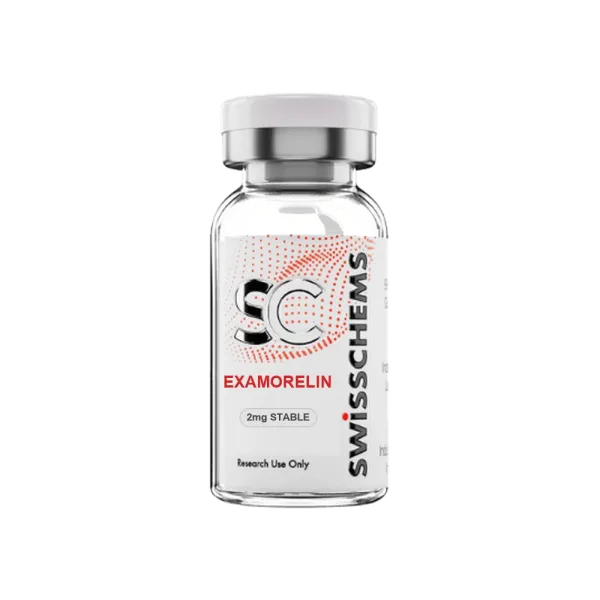
Hexarelin (Examorelin) 2mg
Durante il cambio di confezione potresti ricevere prodotti con l’etichetta precedente o con quella nuova. Formulazione, purezza e qualità restano esattamente le stesse, secondo i nostri standard.
- Carta di credito
- Bonifico bancario (SEPA istantaneo)
- Bonifico bancario (ACH)
- Wise
- Revolut
- Zelle
- Remitly
- Western Union
- Chime
- Altri metodi
-25% su tutto – fino al 31 Ottobre
25% sui prezzi ordinari, in sostituzione degli altri saldi. Cumulabile solo con lo sconto crypto.
Spedizione in giornata per gli ordini USA effettuati entro le 12:00 EST.
Vedi le condizioni di spedizione →Ogni lotto è testato per purezza, potenza e qualità.
Vedi i risultati di laboratorio →Hexarelin (Examorelin) is a synthetic hexapeptide growth hormone secretagogue and one of the most potent GHS-R1a agonists identified. Binding to GHS-R1a activates Gq/11-mediated phospholipase C signalling, resulting in IP3/DAG generation, intracellular calcium mobilization, and downstream secretagogue-associated signalling pathways.
Unlike other members of the GHRP class, Hexarelin also interacts with CD36 (scavenger receptor class B), providing a secondary signalling mechanism independent of GHS-R1a activation.
This dual receptor profile makes Hexarelin a valuable research tool for investigating GHS-R1a pharmacology, receptor-signalling dynamics, secretagogue potency relationships, CD36-mediated signalling pathways, and comparative peptide pharmacology.
Experimental studies have also utilized Hexarelin in investigations of receptor cross-talk, intracellular signalling networks, and peptide-receptor selectivity. Supplied as lyophilized preparation (2 mg/vial).
- High Purity – 99% Purity Guaranteed
- Independently Lab Tested
- Research Grade Quality
- For Laboratory Research Use Only
3D Molecular Structure
Drag to rotate · scroll to zoom| Chemical Formula | C47H58N12O6 |
|---|---|
| Synonyms | Examorelin, EP-23905, MF-6003, His-D-2-Me-Trp-Ala-Trp-D-Phe-Lys-NH2 |
| Molar Mass | 887.05 g/mol |
| CAS Number | 140703-51-1 |
| PubChem CID | 6918297 |
| Total Compound Content | 2 mg per vial |
| Shelf Life | 36 months |
Every batch is independently lab tested for identity, purity and potency. View our lab testing program →
What is the CD36 receptor and why is Hexarelin's activity at this target significant?
CD36 (cluster of differentiation 36), also known as fatty acid translocase (FAT), is a class B scavenger receptor involved in lipid transport, fatty acid uptake, oxidized lipid recognition, and cellular metabolic signalling.
Hexarelin is unique among GHS-R1a agonists in that it also interacts with CD36, providing a second pharmacological mechanism independent of growth hormone secretagogue receptor activation.
This dual receptor profile makes Hexarelin a valuable research tool for investigating receptor-specific signalling pathways, metabolic regulation, lipid-sensing mechanisms, and the distinction between GHS-R1a-mediated and CD36-mediated biological effects.
How does Hexarelin compare to other GHS-R1a agonists in receptor potency studies?
Hexarelin is widely regarded as one of the most potent peptide agonists of GHS-R1a. Comparative pharmacology studies frequently utilize Hexarelin as a reference compound when evaluating receptor affinity, agonist efficacy, signalling kinetics, and downstream pathway activation among members of the GHRP class.
Its high receptor potency and well-characterized signalling profile have established it as a standard tool in GHS-R1a research and comparative secretagogue pharmacology.
What research applications are uniquely associated with Hexarelin?
In addition to its role in GHS-R1a signalling research, Hexarelin is used to investigate CD36-associated pathways, receptor cross-talk mechanisms, lipid-regulated signalling networks, cellular stress-response pathways, and comparative receptor pharmacology. The presence of both GHS-R1a and CD36 activity allows researchers to design experiments that differentiate receptor-specific signalling events and examine the interaction between distinct peptide-responsive pathways within the same experimental system.