Uso del prodotto: Questo prodotto è destinato esclusivamente alla ricerca.
Tutte le informazioni sui prodotti presenti su questo sito hanno scopo esclusivamente educativo. Qualsiasi forma di introduzione nel corpo di esseri umani o animali è severamente vietata dalla legge. Questo prodotto deve essere maneggiato solo da professionisti abilitati e qualificati. Non è un farmaco, un alimento o un cosmetico e non deve essere etichettato, utilizzato o presentato come tale.
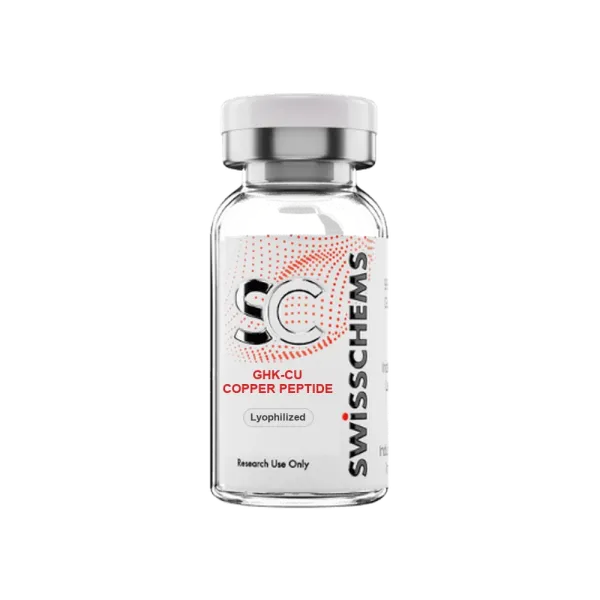
GHK-Cu Copper Peptide
Durante il cambio di confezione potresti ricevere prodotti con l’etichetta precedente o con quella nuova. Formulazione, purezza e qualità restano esattamente le stesse, secondo i nostri standard.
- Carta di credito
- Bonifico bancario (SEPA istantaneo)
- Bonifico bancario (ACH)
- Wise
- Revolut
- Zelle
- Remitly
- Western Union
- Chime
- Altri metodi
-25% su tutto – fino al 31 Ottobre
25% sui prezzi ordinari, in sostituzione degli altri saldi. Cumulabile solo con lo sconto crypto.
Spedizione in giornata per gli ordini USA effettuati entro le 12:00 EST.
Vedi le condizioni di spedizione →Ogni lotto è testato per purezza, potenza e qualità.
Vedi i risultati di laboratorio →GHK-Cu is a synthetic tripeptide-copper complex demonstrating specific molecular interactions in experimental models. The compound consists of glycyl-L-histidyl-L-lysine sequence chelated with copper, showing unique binding properties in laboratory studies. Research indicates selective cellular pathway modulation in controlled experimental conditions.
- High Purity – 99% Purity Guaranteed
- Independently Lab Tested
- Research Grade Quality
- For Laboratory Research Use Only
3D Molecular Structure
Drag to rotate · scroll to zoom| Chemical Formula | C14H23CuN6O4+ |
|---|---|
| Synonyms | Prezatide copper, Copper peptide, BCP32687, SY253680, GHK copper; CG-copper peptide; [N2-(N-Glycyl-L-histidyl)-L-lysinato(2-)]copper |
| Molar Mass | 402.92 g/mol |
| CAS Number | 89030-95-5 |
| PubChem CID | 78122578 |
| Total Compound Content | 50 mg per vial |
| Shelf Life | 36 months |
Results refer to the tested sample. Check the batch and date in the report.
What role does the copper(II) ion play in the structure of GHK-Cu?
The copper(II) ion is an essential structural component of GHK-Cu, forming a stable coordination complex through interactions with the Gly-His-Lys tripeptide. This metal-binding arrangement influences the physicochemical properties of the complex and has made GHK-Cu a widely studied model system for investigating copper coordination chemistry, ligand-metal interactions, metallopeptide stability, and copper-dependent signaling mechanisms.
What signaling pathways have been associated with GHK-Cu in experimental investigations?
Research involving GHK-Cu has examined interactions with signaling networks associated with extracellular matrix regulation, structural protein organization, metal-ion transport processes, and peptide-mediated cellular communication. Additional investigations have explored relationships between GHK-Cu and copper-dependent regulatory proteins, redox-associated signaling pathways, and metalloprotein activity, contributing to a broader understanding of metallopeptide signaling systems.
What distinguishes GHK-Cu from other copper-binding peptide complexes?
GHK-Cu combines a well-characterized tripeptide scaffold with high-affinity copper(II) coordination, resulting in a defined metallopeptide structure that has been extensively investigated in coordination chemistry and signaling research. Its established molecular architecture and documented metal-binding properties have made it a valuable reference compound for studies examining ligand-metal interactions, metallopeptide pharmacology, structure-function relationships, and copper-dependent regulatory mechanisms.