Utilisation : Ce produit est destiné uniquement à la recherche.
Toutes les informations sur les produits présentes sur ce site sont fournies à titre éducatif uniquement. Toute forme d’introduction dans le corps humain ou animal est strictement interdite par la loi. Ce produit doit être manipulé uniquement par des professionnels agréés et qualifiés. Il ne s’agit pas d’un médicament, d’un aliment ou d’un cosmétique et il ne doit pas être présenté, utilisé ou étiqueté comme tel.
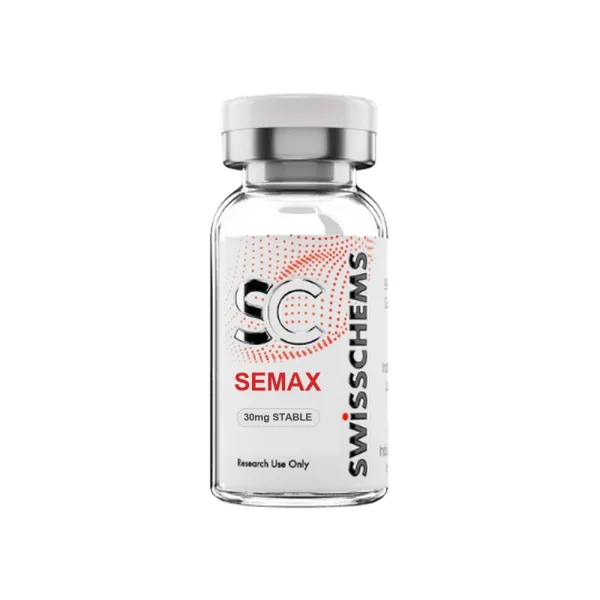
Semax 30mg
Pendant notre changement d’emballage, vous pouvez recevoir des produits avec l’ancienne ou la nouvelle étiquette. La formulation, la pureté et la qualité restent exactement les mêmes, selon nos standards.
- Carte de crédit
- Virement bancaire (SEPA instantané)
- Virement bancaire (ACH)
- Wise
- Revolut
- Zelle
- Remitly
- Western Union
- Chime
- Autres
-25% sur tout – jusqu’au 31 octobre
25% sur les prix habituels, en remplacement des autres soldes. Cumulable uniquement avec la remise crypto.
Expédition le jour même pour les commandes aux États-Unis passées avant 12 h EST.
Voir la politique de livraison →Chaque lot est testé pour sa pureté, sa puissance et sa qualité.
Voir les résultats d’analyse →Semax (MEHFPGP) is a synthetic heptapeptide analogue of the ACTH(4-10) fragment developed to retain specific peptide-signaling properties while exhibiting a distinct pharmacological profile.
Experimental investigations have examined its interactions with melanocortin-associated signaling pathways, peptide-mediated regulatory networks, transcriptional control mechanisms, and signal transduction processes. Studies have also explored its influence on molecular signaling systems, receptor-associated regulatory pathways, and peptide-dependent cellular communication mechanisms.
Research applications include neuropeptide pharmacology, melanocortin pathway investigation, peptide-signaling research, transcriptional regulation studies, receptor-ligand interaction analysis, and mechanistic evaluation of peptide-mediated signaling systems.
- High Purity – 99% Purity Guaranteed
- Independently Lab Tested
- Research Grade Quality
- For Laboratory Research Use Only
3D Molecular Structure
Drag to rotate · scroll to zoom| Chemical Formula | C37H51N9O10S |
|---|---|
| Synonyms | MEHFPGP, (Pro8,Gly9,Pro10)ACTH-(4-10), H-Met-Glu-His-Phe-Pro-Gly-Pro-OH |
| Molar Mass | 813.93 g/mol |
| CAS Number | 80714-61-0 |
| PubChem CID | 9811102 |
| Total Compound Content | 30 mg per vial |
| Shelf Life | 36 months |
Every batch is independently lab tested for identity, purity and potency. View our lab testing program →
What is the relationship between Semax and ACTH in terms of receptor pharmacology?
Semax is derived from the ACTH(4-10) sequence, a fragment of the larger proopiomelanocortin (POMC)-derived peptide family. The ACTH(4-10) region retains interactions with melanocortin-associated signaling systems while exhibiting a pharmacological profile distinct from full-length ACTH.
Experimental investigations have examined Semax in relation to melanocortin receptor-associated pathways, peptide-mediated regulatory mechanisms, transcriptional control processes, and downstream signaling networks. These characteristics make Semax a useful research tool for studies of melanocortin pharmacology and peptide-signaling mechanisms.
How does Semax interact with molecular signaling pathways in experimental systems?
Experimental investigations have examined Semax in relation to ERK/MAPK-associated signaling networks, transcriptional regulation processes, and peptide-mediated regulatory pathways.
While the precise molecular mechanisms remain incompletely characterized, studies have explored interactions with receptor-associated signaling systems, intracellular communication pathways, and downstream regulatory networks involved in peptide pharmacology.
These characteristics have established Semax as a valuable research tool for investigations of signal transduction mechanisms and peptide-mediated molecular regulation.
Why is the Pro-Gly-Pro C-terminal motif of Semax pharmacologically significant?
Semax contains a C-terminal Pro-Gly-Pro extension that influences peptide stability characteristics and enzymatic degradation susceptibility relative to shorter ACTH-derived fragments. This structural modification alters physicochemical properties and contributes to its distinct pharmacological profile.
The Pro-Gly-Pro motif is frequently examined in studies of peptide structure-function relationships, enzymatic processing mechanisms, molecular stability, and the impact of sequence modifications on peptide-associated signaling systems.