Utilisation : Ce produit est destiné uniquement à la recherche.
Toutes les informations sur les produits présentes sur ce site sont fournies à titre éducatif uniquement. Toute forme d’introduction dans le corps humain ou animal est strictement interdite par la loi. Ce produit doit être manipulé uniquement par des professionnels agréés et qualifiés. Il ne s’agit pas d’un médicament, d’un aliment ou d’un cosmétique et il ne doit pas être présenté, utilisé ou étiqueté comme tel.
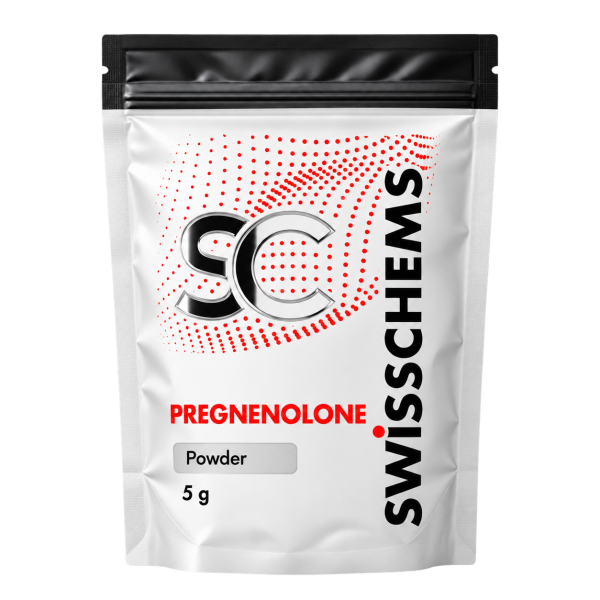
Pregnenolone – Powder, 5 grams
Pendant notre changement d’emballage, vous pouvez recevoir des produits avec l’ancienne ou la nouvelle étiquette. La formulation, la pureté et la qualité restent exactement les mêmes, selon nos standards.
- Carte de crédit
- Virement bancaire (SEPA instantané)
- Virement bancaire (ACH)
- Wise
- Revolut
- Zelle
- Remitly
- Western Union
- Chime
- Autres
-25% sur tout – jusqu’au 31 octobre
25% sur les prix habituels, en remplacement des autres soldes. Cumulable uniquement avec la remise crypto.
Expédition le jour même pour les commandes aux États-Unis passées avant 12 h EST.
Voir la politique de livraison →Chaque lot est testé pour sa pureté, sa puissance et sa qualité.
Voir les résultats d’analyse →Pregnenolone is a pregnane-class steroid derived enzymatically from cholesterol via the cholesterol side-chain cleavage enzyme (CYP11A1), positioned as the common biosynthetic precursor for the entire downstream steroidogenic cascade. Research interest centers on its role both as a steroidogenesis intermediate and as a neurosteroid with independent signalling activity in the central nervous system.
Research applications include steroidogenic pathway studies, neurosteroid receptor pharmacology, and CYP11A1 enzyme kinetics research.
- High Purity – 99% Purity Guaranteed
- Independently Lab Tested
- Research Grade Quality
- For Laboratory Research Use Only
3D Molecular Structure
Drag to rotate · scroll to zoom| Chemical Formula | C21H32O2 |
|---|---|
| Synonyms | pregn-5-en-3β-ol-20-one, 3beta-Hydroxypregn-5-en-20-one, Arthenolone, Pregnetan |
| Molar Mass | 316.5 g/mol |
| CAS Number | 145-13-1 |
| PubChem CID | 8955 |
| Total Compound Content | 5 grams |
| Shelf Life | 36 months |
Every batch is independently lab tested for identity, purity and potency. View our lab testing program →
What is pregnenolone's role as the common precursor in the steroidogenic biosynthetic cascade?
Pregnenolone is produced from cholesterol by the mitochondrial enzyme CYP11A1 (cholesterol side-chain cleavage enzyme), representing the first and rate-limiting committed step of steroidogenesis.
From pregnenolone, tissue-specific enzymatic pathways branch toward progesterone and downstream mineralocorticoids/glucocorticoids, or toward dehydroepiandrosterone (DHEA) and downstream androgens/estrogens, depending on which steroidogenic enzymes are expressed in a given tissue.
Research using pregnenolone as a substrate in steroidogenic cell models allows characterisation of which downstream enzymatic branch point is rate-limiting under specific experimental conditions.
How is pregnenolone studied as a neurosteroid independent of its role in classical steroidogenesis?
Pregnenolone and its sulfated derivative (pregnenolone sulfate) are investigated for direct, rapid modulatory effects at neuronal ligand-gated ion channels — including GABA-A and NMDA receptor complexes — that occur independently of the genomic nuclear steroid receptor pathway used by downstream steroid hormones. Electrophysiological assays (patch-clamp recording of GABA-A or NMDA receptor currents) in the presence of pregnenolone or pregnenolone sulfate are the standard method for characterising this neurosteroid activity, distinct from steroidogenic enzyme-kinetics approaches used to study its biosynthetic role.
What experimental models are used to study CYP11A1 enzyme kinetics with pregnenolone as the reaction product?
Steroidogenic cell lines (such as adrenocortical or Leydig cell-derived models) and isolated mitochondrial preparations expressing CYP11A1 are standard systems for studying cholesterol-to-pregnenolone conversion kinetics, typically using cholesterol substrate (often radiolabeled or isotope-labeled) and quantifying pregnenolone product formation by mass spectrometry or immunoassay over time. These models allow researchers to characterise how experimental conditions or co-treatments affect this rate-limiting steroidogenic step.