Utilisation : Ce produit est destiné uniquement à la recherche.
Toutes les informations sur les produits présentes sur ce site sont fournies à titre éducatif uniquement. Toute forme d’introduction dans le corps humain ou animal est strictement interdite par la loi. Ce produit doit être manipulé uniquement par des professionnels agréés et qualifiés. Il ne s’agit pas d’un médicament, d’un aliment ou d’un cosmétique et il ne doit pas être présenté, utilisé ou étiqueté comme tel.
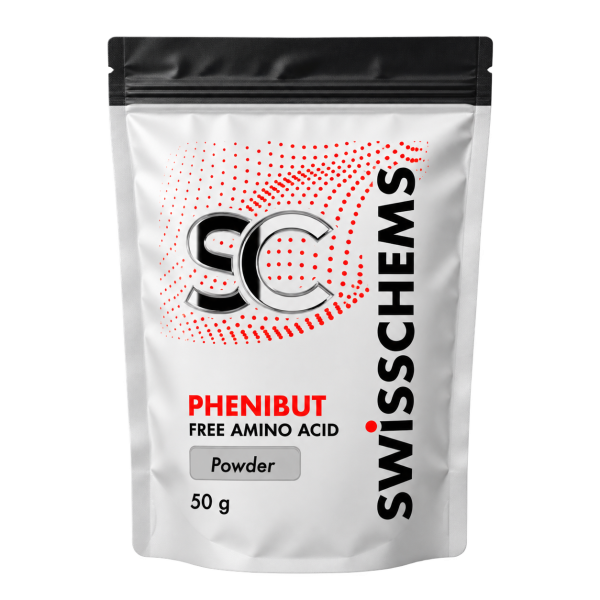
Phenibut Free Amino Acid – Powder, 50 grams
Pendant notre changement d’emballage, vous pouvez recevoir des produits avec l’ancienne ou la nouvelle étiquette. La formulation, la pureté et la qualité restent exactement les mêmes, selon nos standards.
- Carte de crédit
- Virement bancaire (SEPA instantané)
- Virement bancaire (ACH)
- Wise
- Revolut
- Zelle
- Remitly
- Western Union
- Chime
- Autres
-25% sur tout – jusqu’au 31 octobre
25% sur les prix habituels, en remplacement des autres soldes. Cumulable uniquement avec la remise crypto.
Expédition le jour même pour les commandes aux États-Unis passées avant 12 h EST.
Voir la politique de livraison →Chaque lot est testé pour sa pureté, sa puissance et sa qualité.
Voir les résultats d’analyse →Phenibut Free Amino Acid (FAA) is the free base form of β-phenyl-γ-aminobutyric acid, distinct from Phenibut HCL in that it lacks the hydrochloride salt component. The free base form has lower molecular weight, different solubility characteristics, and is used in research applications requiring non-salt formulations. It retains the same GABA-B receptor agonist and GABA-A ρ modulator pharmacological profile as the HCL form.
- High Purity – 99% Purity Guaranteed
- Independently Lab Tested
- Research Grade Quality
- For Laboratory Research Use Only
3D Molecular Structure
Drag to rotate · scroll to zoom| Chemical Formula | C10H13NO2 |
|---|---|
| Synonyms | β-Phenyl-GABA (free base), γ-Amino-β-phenylbutyric acid, Fenibut |
| Molar Mass | 179.219 g/mol |
| CAS Number | 1078-21-3 |
| PubChem CID | 14113 |
| Total Compound Content | 50 g powder |
| Shelf Life | 36 months |
Results refer to the tested sample. Check the batch and date in the report.
What is the practical difference between Phenibut HCL and Phenibut Free Amino Acid for research use?
The primary differences are solubility and formulation compatibility. Phenibut HCL is highly water-soluble (~200 mg/mL) and suited to aqueous solution preparation. Phenibut Free Amino Acid (free base) has lower water solubility (~10–15 mg/mL) but higher solubility in organic solvents and lipophilic vehicles.
The free base form is preferred for lipophilic formulations, sublingual preparations, or when chloride ions from the HCL salt would confound the assay. Pharmacological activity is equivalent once dissolved; the choice is driven by formulation requirements.
Does the free amino acid form have different pharmacokinetics than the HCL salt?
Once absorbed, both forms deliver the same active moiety (β-phenyl-GABA) to the systemic circulation. The salt form has no independent pharmacological activity — the HCl component dissociates in solution. Any pharmacokinetic differences relate to dissolution rate and absorption site pH dynamics rather than inherent compound differences.
In vivo, both forms are expected to produce equivalent plasma concentration profiles at equimolar doses when formulated appropriately.
At what pH does phenibut free amino acid become ionised, and how does this affect solubility?
Phenibut has a pKa of approximately 4.1 (carboxylic acid) and 9.4 (amino group). At physiological pH (~7.4), it exists predominantly in its zwitterionic form. The free base powder is in its neutral/free base state, which has lower water solubility than the protonated HCL salt form. Solubility increases significantly below pH 5, where protonation of the amino group occurs.
This pH-dependent solubility is relevant to in vitro assay design when working in acidic culture conditions or buffer systems.