Uso del producto: Este producto está destinado exclusivamente a la investigación.
Toda la información de los productos de este sitio web tiene fines exclusivamente educativos. Cualquier forma de introducción en el cuerpo de personas o animales está estrictamente prohibida por la ley. Este producto solo debe ser manipulado por profesionales autorizados y cualificados. No es un medicamento, alimento ni cosmético y no debe etiquetarse, utilizarse ni presentarse como tal.
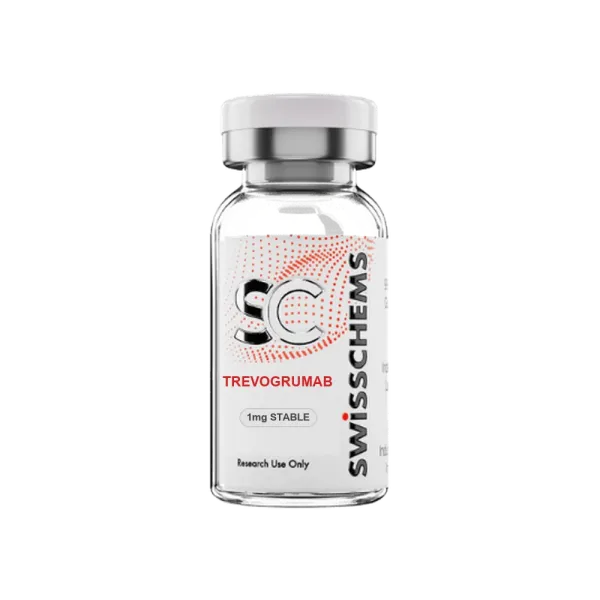
Trevogrumab 1mg
Durante el cambio de envase, puedes recibir productos con la etiqueta anterior o con la nueva. La formulación, la pureza y la calidad siguen siendo exactamente las mismas, según nuestros estándares.
- Tarjeta de crédito
- Transferencia bancaria (SEPA inmediata)
- Transferencia bancaria (ACH)
- Wise
- Revolut
- Zelle
- Remitly
- Western Union
- Chime
- Otros
-25% en todo – hasta el 31 de octubre
25% sobre los precios habituales, en sustitución de otras ofertas. Acumulable solo con el descuento crypto.
Envío en el día para pedidos en EE. UU. realizados antes de las 12:00 EST.
Ver la política de envíos →Devoluciones sin complicaciones en 30 días para productos sin abrir.
Ver la política de devoluciones →Cada lote se analiza para comprobar su pureza, potencia y calidad.
Ver resultados de laboratorio →Trevogrumab (REGN1033, SAR-391786) is a fully human monoclonal antibody engineered for high-affinity, selective neutralisation of myostatin (GDF-8), a TGF-beta superfamily ligand that functions as a primary negative regulator of skeletal muscle mass. Research interest centers on its specificity for myostatin without cross-reactivity to other ActRIIB-binding ligands such as activins or GDF-11.
Research applications include myostatin pathway antagonist research, antibody-based ligand neutralisation studies, and comparative ActRIIB pathway inhibitor pharmacology.
- High Purity – 99% Purity Guaranteed
- Independently Lab Tested
- Research Grade Quality
- For Laboratory Research Use Only
3D Molecular Structure
Drag to rotate · scroll to zoom| Chemical Formula | C6374H9884N1696O2018S46 |
|---|---|
| Synonyms | REGN-1033 (REGN1033), Anti-GDF8/Myostatin antibody, SAR-391786 |
| CAS Number | 1429201-24-0 |
| PubChem CID | 384585220 |
| Total Compound Content | 1mg per vial |
| Shelf Life | 36 months |
Every batch is independently lab tested for identity, purity and potency. View our lab testing program →
How does Trevogrumab's myostatin selectivity distinguish it from broad-spectrum ActRIIB ligand traps in research?
Trevogrumab is engineered as a highly specific anti-myostatin (GDF-8) antibody, binding myostatin directly to prevent its engagement of ActRIIB, with minimal cross-reactivity to other TGF-beta superfamily ligands. This contrasts with soluble ActRIIB-Fc fusion protein ligand traps, which sequester myostatin alongside activins, GDF-11, and BMP-9/10 indiscriminately.
For research questions requiring isolation of myostatin-specific pathway contributions — without confounding effects from co-inhibited activin or BMP signalling — trevogrumab's selective mechanism is the appropriate experimental tool.
What assay formats are used to confirm Trevogrumab's neutralizing potency against myostatin-induced signaling?
Cell-based Smad2/3 reporter assays — using myoblast cell lines such as C2C12 transfected with a Smad-responsive luciferase construct — are standard for quantifying trevogrumab's capacity to block myostatin-induced Smad2/3 transcriptional activation in a dose-dependent manner, typically expressed as an IC50 or neutralising dose. Surface plasmon resonance (SPR) or other direct binding-affinity methods are used in parallel to characterise trevogrumab's intrinsic binding kinetics (Kd, on/off rates) to recombinant myostatin independent of the cell-based functional readout.
What rodent model endpoints are used to evaluate Trevogrumab's functional effects on skeletal muscle mass?
Rodent studies investigating myostatin pathway antagonists typically measure lean body mass and individual muscle wet weight (e.g. gastrocnemius, quadriceps) following a defined dosing period, alongside functional measures such as grip strength or treadmill exercise capacity. These studies often include muscle fiber cross-sectional area histology to confirm hypertrophy at the cellular level, and serum myostatin/antibody pharmacokinetic sampling to correlate systemic drug exposure with the magnitude of the observed muscle-mass phenotype.