Uso del producto: Este producto está destinado exclusivamente a la investigación.
Toda la información de los productos de este sitio web tiene fines exclusivamente educativos. Cualquier forma de introducción en el cuerpo de personas o animales está estrictamente prohibida por la ley. Este producto solo debe ser manipulado por profesionales autorizados y cualificados. No es un medicamento, alimento ni cosmético y no debe etiquetarse, utilizarse ni presentarse como tal.
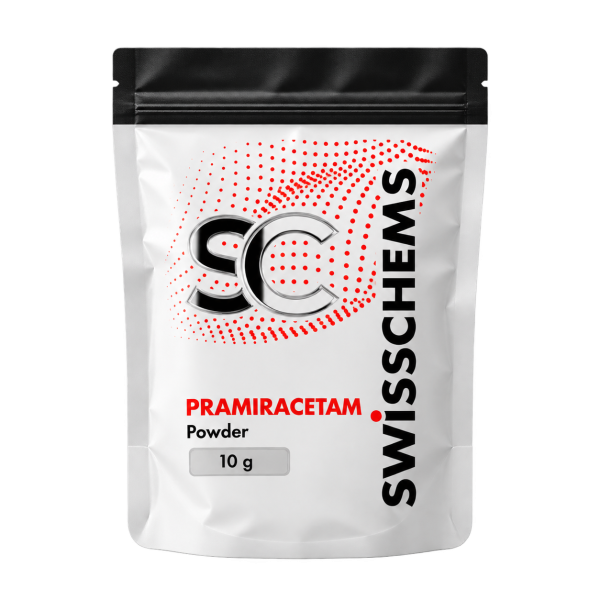
Pramiracetam – Powder, 10 grams
Durante el cambio de envase, puedes recibir productos con la etiqueta anterior o con la nueva. La formulación, la pureza y la calidad siguen siendo exactamente las mismas, según nuestros estándares.
- Tarjeta de crédito
- Transferencia bancaria (SEPA inmediata)
- Transferencia bancaria (ACH)
- Wise
- Revolut
- Zelle
- Remitly
- Western Union
- Chime
- Otros
-25% en todo – hasta el 31 de octubre
25% sobre los precios habituales, en sustitución de otras ofertas. Acumulable solo con el descuento crypto.
Envío en el día para pedidos en EE. UU. realizados antes de las 12:00 EST.
Ver la política de envíos →Devoluciones sin complicaciones en 30 días para productos sin abrir.
Ver la política de devoluciones →Cada lote se analiza para comprobar su pureza, potencia y calidad.
Ver resultados de laboratorio →Pramiracetam is a synthetic pyrrolidinone derivative within the racetam structural class, distinguished from other racetam-family compounds by a diisopropylaminoethyl substituent and reported high lipophilicity. Research interest centers on its proposed effects on high-affinity choline uptake (HACU) in hippocampal tissue models, a mechanism distinct from direct cholinergic receptor agonism.
Research applications include HACU pathway studies, racetam structure-activity relationship investigation, and comparative pyrrolidinone pharmacology.
- High Purity – 99% Purity Guaranteed
- Independently Lab Tested
- Research Grade Quality
- For Laboratory Research Use Only
3D Molecular Structure
Drag to rotate · scroll to zoom| Chemical Formula | C14H27N3O2 |
|---|---|
| Synonyms | Pramiracetam 68497-62-1, Pramiracetam [INN], N-[2-[di(propan-2-yl)amino]ethyl]-2-(2-oxopyrrolidin-1-yl)acetamide, UNII-4449F8I3LE |
| Molar Mass | 269.38 g/mol |
| CAS Number | 68497-62-1 |
| PubChem CID | 51712 |
| Total Compound Content | 10 grams |
| Shelf Life | 36 months |
Every batch is independently lab tested for identity, purity and potency. View our lab testing program →
What is the proposed mechanism of pramiracetam's effect on high-affinity choline uptake (HACU)?
Pramiracetam is studied for its capacity to enhance the activity of the high-affinity, sodium-dependent choline transporter located on presynaptic cholinergic nerve terminals, which controls the rate-limiting step of choline availability for acetylcholine biosynthesis.
This is a presynaptic transport-modulating mechanism rather than direct activation of muscarinic or nicotinic acetylcholine receptors, distinguishing pramiracetam's research profile from receptor-targeted cholinergic agonists. Synaptosome uptake assays using radiolabeled choline are the standard method for quantifying this effect kinetically (Km, Vmax) under compound exposure.
How does pramiracetam's structure relate to its classification within the racetam compound family?
Pramiracetam shares the 2-oxopyrrolidinone (racetam) core structure common to this compound class but is distinguished by a diisopropylaminoethyl acetamide substituent, which confers substantially higher lipophilicity than simpler racetam-family members. Structure-activity relationship research examining the racetam series often uses pramiracetam as a reference point for how side-chain modifications to the shared pyrrolidinone scaffold influence pharmacological profile, including blood-brain barrier penetration characteristics relevant to CNS-targeted in vivo study design.
What experimental models are used to study pramiracetam's effects on hippocampal cholinergic function?
Ex vivo hippocampal slice preparations and isolated synaptosome fractions are standard models for studying pramiracetam's effects on cholinergic terminal function, typically measuring choline uptake kinetics directly or acetylcholine release via microdialysis or amperometric methods following compound exposure. Behavioral correlates in rodent models (such as memory-task performance) are sometimes paired with these biochemical measures to connect presynaptic cholinergic effects to functional outcomes, though researchers should treat behavioral and biochemical endpoints as separate lines of evidence requiring independent validation.