Uso del producto: Este producto está destinado exclusivamente a la investigación.
Toda la información de los productos de este sitio web tiene fines exclusivamente educativos. Cualquier forma de introducción en el cuerpo de personas o animales está estrictamente prohibida por la ley. Este producto solo debe ser manipulado por profesionales autorizados y cualificados. No es un medicamento, alimento ni cosmético y no debe etiquetarse, utilizarse ni presentarse como tal.
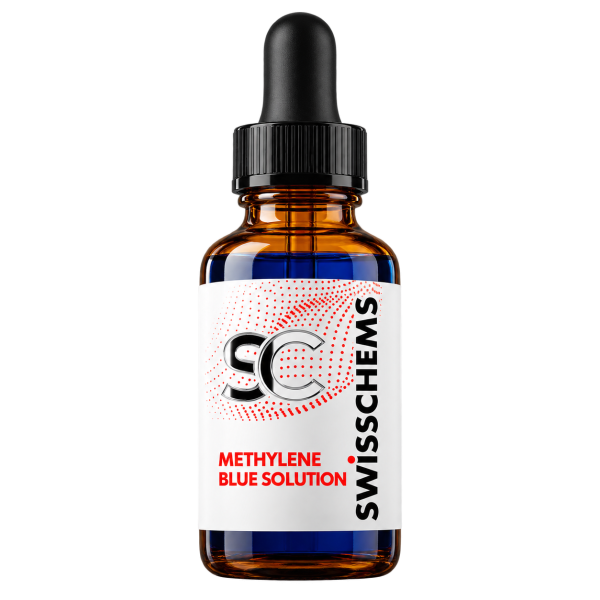
Methylene Blue Solution
Durante el cambio de envase, puedes recibir productos con la etiqueta anterior o con la nueva. La formulación, la pureza y la calidad siguen siendo exactamente las mismas, según nuestros estándares.
- Tarjeta de crédito
- Transferencia bancaria (SEPA inmediata)
- Transferencia bancaria (ACH)
- Wise
- Revolut
- Zelle
- Remitly
- Western Union
- Chime
- Otros
-25% en todo – hasta el 31 de octubre
25% sobre los precios habituales, en sustitución de otras ofertas. Acumulable solo con el descuento crypto.
Envío en el día para pedidos en EE. UU. realizados antes de las 12:00 EST.
Ver la política de envíos →Devoluciones sin complicaciones en 30 días para productos sin abrir.
Ver la política de devoluciones →Cada lote se analiza para comprobar su pureza, potencia y calidad.
Ver resultados de laboratorio →Methylene Blue solution (5 mg/ml) provides the same phenothiazine redox mediator as the capsule format in a pre-dissolved aqueous solution, enabling precise volume-based dosing and immediate use without powder weighing or dissolution steps.
The solution format is suited to parenteral administration route studies (IP, IV, SC) in preclinical models and to in vitro assays requiring defined aqueous methylene blue concentrations. Research applications are identical to the capsule format: mitochondrial ETC bypass, tau aggregation inhibition, MAO inhibition, and photodynamic research.
- High Purity – 99% Purity Guaranteed
- Independently Lab Tested
- Research Grade Quality
- For Laboratory Research Use Only
3D Molecular Structure
Drag to rotate · scroll to zoom| Chemical Formula | C16H18ClN3S |
|---|---|
| Synonyms | Methylthioninium chloride, 3,7-Bis(dimethylamino)phenothiazin-5-ium chloride |
| Molar Mass | 319.85 g/mol |
| CAS Number | 61-73-4 |
| PubChem CID | 6099 |
| Total Compound Content | 150 mg (5 mg per 1 ml) |
| Shelf Life | 24 months |
Every batch is independently lab tested for identity, purity and potency. View our lab testing program →
What are the practical advantages of methylene blue solution over capsules for preclinical research?
The solution format enables parenteral administration routes (IV, IP, SC) not feasible with capsules, which are limited to oral delivery. For in vitro assays, direct dilution from the 5 mg/ml stock into assay medium avoids organic solvent introduction that capsule powder dissolution typically requires.
Volume-based dosing also eliminates powder weighing steps and the associated measurement error in small-dose animal studies. The capsule format is preferred for oral administration protocols where solution handling is not required.
What concentration range should researchers use for methylene blue in mitochondrial ETC bypass applications?
For mitochondrial ETC Complex III bypass studies, methylene blue is typically active at nanomolar to low micromolar concentrations in cell-based assays (0.1–10 µM). At these concentrations, the redox potential of MB/MBH2 cycling enables electron shuttling between NADH/Complex I and cytochrome c, bypassing Complex III.
Importantly, MB exhibits hormetic behaviour — low concentrations are cytoprotective (ETC enhancement), while higher concentrations (>10–100 µM) can be pro-oxidant. The 5 mg/ml stock (15.6 mM) requires approximately 1,000-fold dilution for typical assay working concentrations.
How does the methylene blue solution format support photodynamic research applications?
Methylene Blue absorbs maximally at 664 nm and, upon irradiation at this wavelength, undergoes intersystem crossing to its excited triplet state, which transfers energy to molecular oxygen to generate singlet oxygen (¹O₂) — the primary cytotoxic species in photodynamic applications.
The solution format simplifies preparation of defined MB concentrations for photosensitisation experiments, enables even distribution in assay well plates without dissolution heterogeneity, and allows precise control of photosensitiser concentration. Irradiation source intensity, exposure duration, and MB concentration are the key experimental variables in photodynamic research protocols.