Uso del producto: Este producto está destinado exclusivamente a la investigación.
Toda la información de los productos de este sitio web tiene fines exclusivamente educativos. Cualquier forma de introducción en el cuerpo de personas o animales está estrictamente prohibida por la ley. Este producto solo debe ser manipulado por profesionales autorizados y cualificados. No es un medicamento, alimento ni cosmético y no debe etiquetarse, utilizarse ni presentarse como tal.
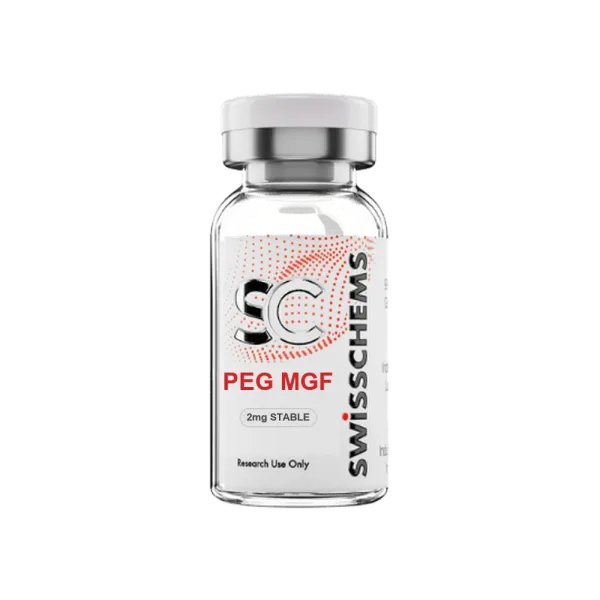
PEG MGF 2mg
Durante el cambio de envase, puedes recibir productos con la etiqueta anterior o con la nueva. La formulación, la pureza y la calidad siguen siendo exactamente las mismas, según nuestros estándares.
- Tarjeta de crédito
- Transferencia bancaria (SEPA inmediata)
- Transferencia bancaria (ACH)
- Wise
- Revolut
- Zelle
- Remitly
- Western Union
- Chime
- Otros
-25% en todo – hasta el 31 de octubre
25% sobre los precios habituales, en sustitución de otras ofertas. Acumulable solo con el descuento crypto.
Envío en el día para pedidos en EE. UU. realizados antes de las 12:00 EST.
Ver la política de envíos →Devoluciones sin complicaciones en 30 días para productos sin abrir.
Ver la política de devoluciones →Cada lote se analiza para comprobar su pureza, potencia y calidad.
Ver resultados de laboratorio →PEG-MGF (Pegylated Mechano Growth Factor) is a PEGylated derivative of mechano growth factor (MGF), an alternatively spliced isoform of the IGF-1 gene. PEGylation substantially alters the compound's pharmacokinetic profile by increasing molecular size and reducing clearance, enabling prolonged exposure relative to native MGF.
Experimental investigations have examined PEG MGF's interactions with IGF-1-associated signaling pathways, including PI3K/Akt, MAPK/ERK, and other regulatory networks involved in cellular growth and differentiation processes.
Research has explored its role in satellite cell-associated signaling, myogenic pathway regulation, growth factor-mediated signal transduction, and comparative investigations of IGF-1 splice variants.
These characteristics make PEG-MGF a valuable research tool for studies of myogenesis-associated pathways, IGF-1 isoform pharmacology, growth factor signaling mechanisms, and cellular differentiation processes.
- High Purity – 99% Purity Guaranteed
- Independently Lab Tested
- Research Grade Quality
- For Laboratory Research Use Only
| Chemical Formula | C121H200N42O39 |
|---|---|
| Synonyms | Pegylated Mechano Growth Factor, PEG-MGF, PEG IGF-1 Ec |
| Molar Mass | 2,867.14 g/mol |
| CAS Number | 108174-48-7 |
| PubChem CID | N/A |
| Total Compound Content | 2 mg per vial |
| Shelf Life | 36 months |
Every batch is independently lab tested for identity, purity and potency. View our lab testing program →
What is the mechanistic difference between PEG-MGF and IGF-1 LR3 in research models?
PEG-MGF and IGF-1 LR3 are both derived from the IGF-1 signaling system but are investigated for distinct aspects of growth factor biology. IGF-1 LR3 is primarily utilized in studies of IGF-1 receptor-mediated signaling pathways, including PI3K/Akt and MAPK/ERK regulatory networks.
PEG-MGF, derived from the MGF splice variant of IGF-1, is frequently investigated in studies of satellite cell-associated signaling, cellular proliferation mechanisms, myogenic pathway regulation, and growth factor-mediated cellular responses. Together, they provide complementary tools for examining different dimensions of IGF-1-associated signaling biology.
Why is PEGylation used in PEG-MGF research?
PEGylation involves covalent attachment of polyethylene glycol chains to a peptide structure, increasing molecular size and reducing susceptibility to enzymatic degradation. This modification substantially extends biological persistence relative to native MGF while preserving the compound's utility as a research tool.
PEGylation is widely employed in peptide pharmacology to improve stability, alter pharmacokinetic properties, and enable investigation of signaling pathways over extended experimental timeframes.
What role does PEG-MGF play in satellite cell and myogenesis research?
PEG-MGF is widely utilized in studies of satellite cell-associated signaling pathways, cellular proliferation mechanisms, growth factor-mediated regulation, and myogenic biology. Experimental investigations have examined its interactions with signaling networks involved in cellular differentiation, tissue remodeling processes, and growth factor-regulated molecular pathways.
These characteristics make PEG-MGF a valuable research tool for mechanistic studies of satellite cell biology, myogenesis-associated signaling, and IGF-1 splice variant pharmacology.