Uso del producto: Este producto está destinado exclusivamente a la investigación.
Toda la información de los productos de este sitio web tiene fines exclusivamente educativos. Cualquier forma de introducción en el cuerpo de personas o animales está estrictamente prohibida por la ley. Este producto solo debe ser manipulado por profesionales autorizados y cualificados. No es un medicamento, alimento ni cosmético y no debe etiquetarse, utilizarse ni presentarse como tal.
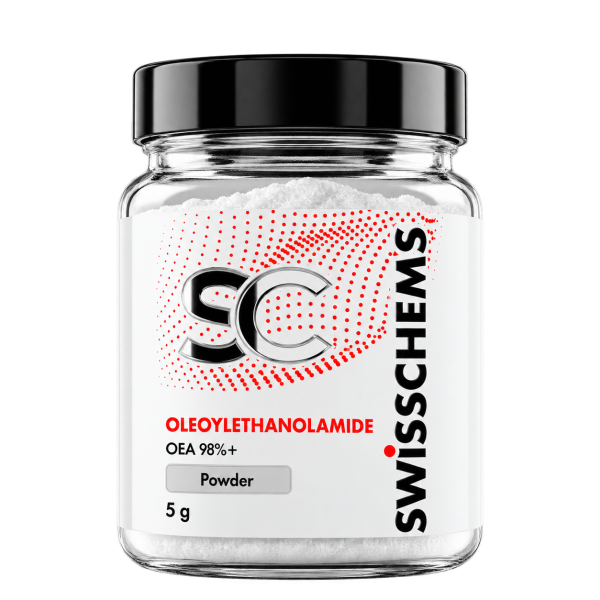
Oleoylethanolamide (OEA) 98%+ – Powder, 5 grams
Durante el cambio de envase, puedes recibir productos con la etiqueta anterior o con la nueva. La formulación, la pureza y la calidad siguen siendo exactamente las mismas, según nuestros estándares.
- Tarjeta de crédito
- Transferencia bancaria (SEPA inmediata)
- Transferencia bancaria (ACH)
- Wise
- Revolut
- Zelle
- Remitly
- Western Union
- Chime
- Otros
-25% en todo – hasta el 31 de octubre
25% sobre los precios habituales, en sustitución de otras ofertas. Acumulable solo con el descuento crypto.
Envío en el día para pedidos en EE. UU. realizados antes de las 12:00 EST.
Ver la política de envíos →Devoluciones sin complicaciones en 30 días para productos sin abrir.
Ver la política de devoluciones →Cada lote se analiza para comprobar su pureza, potencia y calidad.
Ver resultados de laboratorio →Oleoylethanolamide (OEA) is an ethanolamide lipid derived from oleic acid, classified within the N-acylethanolamine family of bioactive lipid signalling molecules. Research interest centers on its function as an endogenous agonist of peroxisome proliferator-activated receptor alpha (PPAR-alpha), a nuclear receptor governing lipid metabolism gene transcription.
Research applications include PPAR-alpha pathway studies, lipid signalling research, and N-acylethanolamine biosynthesis/degradation pathway investigation.
- High Purity – 99% Purity Guaranteed
- Independently Lab Tested
- Research Grade Quality
- For Laboratory Research Use Only
3D Molecular Structure
Drag to rotate · scroll to zoom| Chemical Formula | C20H39NO2 |
|---|---|
| Synonyms | n-oleoylethanolamine, oleoylethanolamide, N-(2-Hydroxyethyl)oleamide, Oleylethanolamide, Oleamide MEA, N-oleoyl ethanolamine |
| Molar Mass | 325.5 g/mol |
| CAS Number | 111-58-0 |
| PubChem CID | 5283454 |
| Total Compound Content | 5 grams |
| Shelf Life | 36 months |
Every batch is independently lab tested for identity, purity and potency. View our lab testing program →
What is the mechanistic basis for OEA's classification as a PPAR-alpha agonist?
OEA binds directly to and activates peroxisome proliferator-activated receptor alpha (PPAR-alpha), a ligand-activated nuclear transcription factor that, upon activation, heterodimerizes with retinoid X receptor (RXR) and binds PPAR-response elements in target gene promoters to upregulate fatty acid oxidation and lipid metabolism genes. Cell-based PPAR-alpha transactivation reporter assays, using a PPAR-response-element-driven luciferase construct, are the standard method for confirming and quantifying OEA's agonist activity at this receptor relative to synthetic PPAR-alpha agonist reference compounds (such as fenofibrate).
How does OEA's biosynthesis and degradation pathway relate to other N-acylethanolamine signaling lipids?
OEA is synthesized via hydrolysis of N-acylphosphatidylethanolamine (the same precursor class that generates other N-acylethanolamines, including the endocannabinoid anandamide) and is degraded by fatty acid amide hydrolase (FAAH), the same enzyme that degrades anandamide. This shared biosynthetic and degradative machinery means that FAAH inhibitor compounds, used in endocannabinoid research, also affect OEA levels — a consideration relevant to experimental design when FAAH inhibitors are used and PPAR-alpha-mediated effects need to be distinguished from cannabinoid-receptor-mediated effects.
What enzymatic assays are used to study FAAH-mediated degradation of OEA in research models?
Standard FAAH activity assays measure the enzymatic hydrolysis rate of OEA (or a fluorogenic/radiolabeled substrate analog) into oleic acid and ethanolamine, typically using tissue homogenates, recombinant FAAH enzyme preparations, or cell lysates. These assays allow researchers to characterise FAAH kinetic parameters (Km, Vmax) with OEA as substrate and to evaluate the potency of FAAH inhibitor compounds, which indirectly elevate OEA tissue concentration by blocking its primary degradation pathway.