Uso del producto: Este producto está destinado exclusivamente a la investigación.
Toda la información de los productos de este sitio web tiene fines exclusivamente educativos. Cualquier forma de introducción en el cuerpo de personas o animales está estrictamente prohibida por la ley. Este producto solo debe ser manipulado por profesionales autorizados y cualificados. No es un medicamento, alimento ni cosmético y no debe etiquetarse, utilizarse ni presentarse como tal.
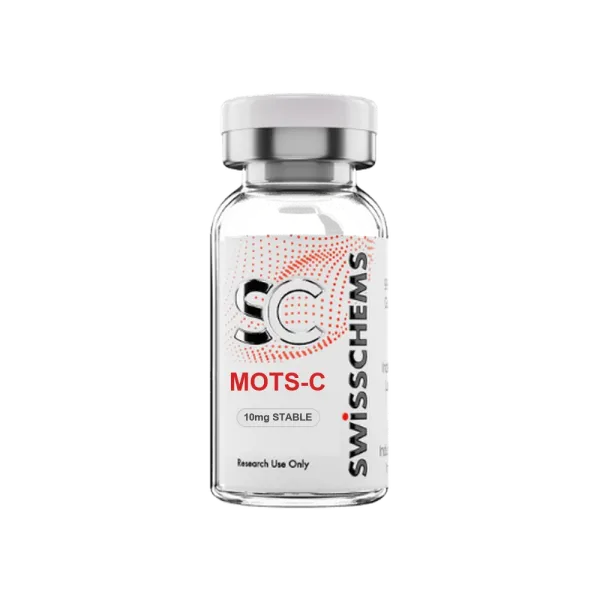
MOTS-C 10mg
Durante el cambio de envase, puedes recibir productos con la etiqueta anterior o con la nueva. La formulación, la pureza y la calidad siguen siendo exactamente las mismas, según nuestros estándares.
- Tarjeta de crédito
- Transferencia bancaria (SEPA inmediata)
- Transferencia bancaria (ACH)
- Wise
- Revolut
- Zelle
- Remitly
- Western Union
- Chime
- Otros
-25% en todo – hasta el 31 de octubre
25% sobre los precios habituales, en sustitución de otras ofertas. Acumulable solo con el descuento crypto.
Envío en el día para pedidos en EE. UU. realizados antes de las 12:00 EST.
Ver la política de envíos →Devoluciones sin complicaciones en 30 días para productos sin abrir.
Ver la política de devoluciones →Cada lote se analiza para comprobar su pureza, potencia y calidad.
Ver resultados de laboratorio →MOTS-C (Mitochondrial Open Reading Frame of the 12S rRNA-c) is a 16-amino-acid peptide encoded within the mitochondrial genome's 12S rRNA region and is classified as a mitochondria-derived peptide (MDP).
Experimental investigations have examined its role in mitochondrial-to-nuclear signaling pathways, intracellular regulatory networks, and adaptive signaling mechanisms associated with mitochondrial communication systems.
Research has also explored interactions with AMP-activated protein kinase (AMPK), FOXO-associated signaling pathways, transcriptional regulatory processes, and downstream signal transduction networks.
Research applications include mitochondrial signaling pathway investigation, AMPK pathway characterization, FOXO signaling studies, mitochondrial communication research, and mechanistic evaluation of mitochondria-derived peptide biology.
- High Purity – 99% Purity Guaranteed
- Independently Lab Tested
- Research Grade Quality
- For Laboratory Research Use Only
3D Molecular Structure
Drag to rotate · scroll to zoom| Chemical Formula | C101H152N28O22S2 |
|---|---|
| Synonyms | Mitochondria-derived peptide, mots-c, EX-A626, Met-Arg-Trp-Gln-Glu-Met-Gly-Tyr-Ile-Phe-Tyr-Pro-Arg-Lys-Leu-Arg |
| Molar Mass | 2,174.62 g/mol |
| CAS Number | 1627580-64-6 |
| PubChem CID | 146675088 |
| Total Compound Content | 10 mg per vial |
| Shelf Life | 36 months |
Results refer to the tested sample. Check the batch and date in the report.
What distinguishes MOTS-C from most other research peptides?
MOTS-C is a 16-amino-acid peptide encoded within the mitochondrial genome, making it part of a relatively small group of mitochondria-derived peptides (MDPs). This unique genetic origin has made MOTS-C a valuable research tool for investigating mitochondrial-to-nuclear communication pathways, intracellular signaling networks, transcriptional regulation mechanisms, and the molecular processes governing mitochondrial signaling systems.
Which signaling pathways have been associated with MOTS-C in experimental investigations?
Research involving MOTS-C has reported interactions with AMP-activated protein kinase (AMPK), FOXO-associated signaling pathways, antioxidant response element (ARE)-associated regulatory networks, and downstream transcriptional processes. These characteristics have established MOTS-C as a useful compound for studying signal transduction mechanisms, pathway-specific regulatory systems, mitochondrial communication networks, and adaptive signaling processes.
How does MOTS-C differ from other mitochondria-derived peptides such as Humanin?
Although both MOTS-C and Humanin are classified as mitochondria-derived peptides, they differ in amino acid sequence, molecular structure, signaling interactions, and pharmacological characteristics. Comparative investigations utilize these peptides to examine distinct aspects of mitochondrial signaling, peptide-mediated regulatory mechanisms, mitochondrial-to-nuclear communication pathways, and structure-function relationships within the broader class of mitochondria-derived peptides.