Verwendung: Dieses Produkt ist ausschließlich für Forschungszwecke bestimmt.
Alle Produktinformationen auf dieser Website dienen ausschließlich Bildungszwecken. Jede Form der Einbringung in den Körper von Menschen oder Tieren ist gesetzlich streng verboten. Dieses Produkt darf nur von zugelassenen und qualifizierten Fachleuten gehandhabt werden. Es ist kein Arzneimittel, Lebensmittel oder Kosmetikum und darf nicht als solches gekennzeichnet, verwendet oder falsch etikettiert werden.
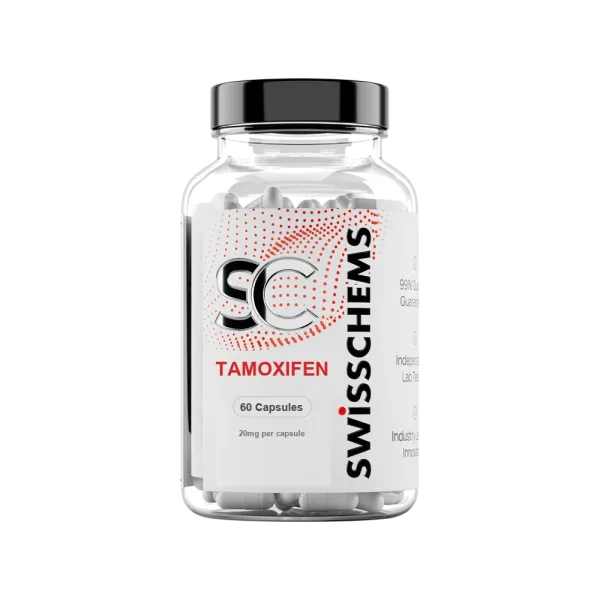
Tamoxifen (20mg/capsule), 60 Capsules
Während der Umstellung unserer Verpackung erhalten Sie möglicherweise Produkte mit dem bisherigen oder dem neuen Etikett. Formulierung, Reinheit und Qualität bleiben nach unseren Standards genau gleich.
- Kreditkarte
- Banküberweisung (SEPA Echtzeit)
- Banküberweisung (ACH)
- Wise
- Revolut
- Zelle
- Remitly
- Western Union
- Chime
- Andere
-25% auf alles – bis 31. Oktober
25% auf reguläre Preise statt anderer Angebote. Nur mit dem Krypto-Zahlungsrabatt kombinierbar.
Jede Charge wird auf Reinheit, Wirksamkeit und Qualität geprüft.
Laborergebnisse ansehen →Tamoxifen is a triphenylethylene-class selective estrogen receptor modulator (SERM) that exhibits ligand-dependent interactions with estrogen receptors ERα and ERβ. Experimental investigations have demonstrated that tamoxifen induces distinct receptor conformations that influence co-regulator recruitment, resulting in differential transcriptional activity across estrogen receptor signaling systems.
Its well-characterized pharmacology has made it a benchmark compound for studies of estrogen receptor modulation, ligand-receptor interactions, receptor conformational dynamics, nuclear receptor signaling, and transcriptional regulation.
Tamoxifen is also widely utilized in inducible CreERT2 systems, where ligand-dependent activation of modified estrogen receptor domains enables controlled recombination in genetic research models.
Research applications include ERα/ERβ pharmacology, SERM mechanism investigation, co-regulator recruitment studies, inducible recombination systems, and comparative analyses of selective estrogen receptor modulators.
- High Purity – 99% Purity Guaranteed
- Independently Lab Tested
- Research Grade Quality
- For Laboratory Research Use Only
3D Molecular Structure
Drag to rotate · scroll to zoom| Chemical Formula | C26H29NO |
|---|---|
| Synonyms | Nolvadex (trade name), ICI-46474, TMX, (Z)-Tamoxifen |
| Molar Mass | 371.52 g/mol |
| CAS Number | 10540-29-1 |
| PubChem CID | 2733526 |
| Total Compound Content | 1,200 mg (20 mg per capsule) |
| Shelf Life | 36 months |
Every batch is independently lab tested for identity, purity and potency. View our lab testing program →
What is tamoxifen's role in CreERT2 conditional recombination systems?
Tamoxifen is widely utilized in CreERT2-based inducible recombination systems, which employ a fusion protein consisting of Cre recombinase linked to a modified estrogen receptor ligand-binding domain. In the absence of ligand binding, the fusion protein remains functionally inactive.
Upon tamoxifen-mediated activation, CreERT2 undergoes conformational changes that permit recombinase activity at loxP recognition sites, enabling controlled genetic recombination. This mechanism has made tamoxifen an indispensable tool for studies requiring inducible and temporally regulated gene modification in experimental systems.
How do tamoxifen metabolites differ from the parent compound in estrogen receptor research?
Tamoxifen undergoes extensive metabolic conversion to several active metabolites, including endoxifen and 4-hydroxytamoxifen, which exhibit substantially greater affinity for estrogen receptors than the parent molecule.
These metabolites are frequently investigated in studies of estrogen receptor binding, ligand-receptor interactions, receptor conformational dynamics, and transcriptional regulation. Their enhanced receptor affinity makes them valuable tools for comparative analyses of estrogen receptor pharmacology and SERM-associated signaling mechanisms.
What distinguishes tamoxifen from other selective estrogen receptor modulators in research applications?
Tamoxifen is characterized by its extensively studied interactions with ERα and ERβ, its well-defined effects on receptor conformation and co-regulator recruitment, and its broad utility in both receptor pharmacology and inducible recombination systems. These properties make it a benchmark compound for investigations of selective estrogen receptor modulation, nuclear receptor signaling, transcriptional regulation, ligand-dependent receptor activity, and comparative studies of SERM pharmacology.