Verwendung: Dieses Produkt ist ausschließlich für Forschungszwecke bestimmt.
Alle Produktinformationen auf dieser Website dienen ausschließlich Bildungszwecken. Jede Form der Einbringung in den Körper von Menschen oder Tieren ist gesetzlich streng verboten. Dieses Produkt darf nur von zugelassenen und qualifizierten Fachleuten gehandhabt werden. Es ist kein Arzneimittel, Lebensmittel oder Kosmetikum und darf nicht als solches gekennzeichnet, verwendet oder falsch etikettiert werden.
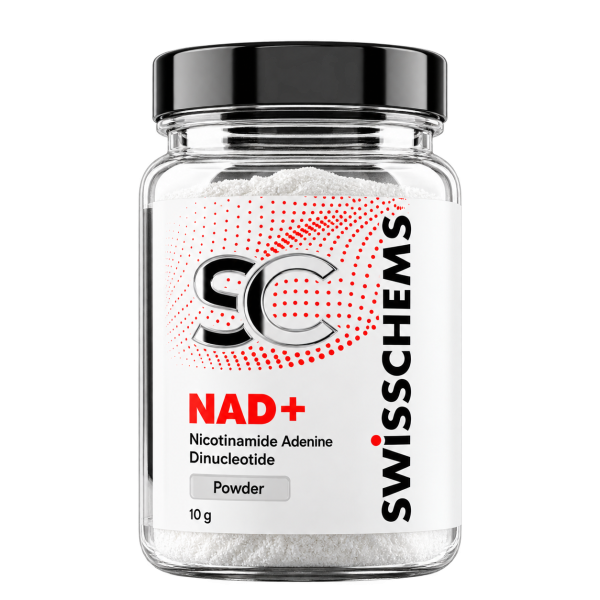
NAD+ (Nicotinamide Adenine Dinucleotide) – Powder, 10 grams
Während der Umstellung unserer Verpackung erhalten Sie möglicherweise Produkte mit dem bisherigen oder dem neuen Etikett. Formulierung, Reinheit und Qualität bleiben nach unseren Standards genau gleich.
- Kreditkarte
- Banküberweisung (SEPA Echtzeit)
- Banküberweisung (ACH)
- Wise
- Revolut
- Zelle
- Remitly
- Western Union
- Chime
- Andere
-25% auf alles – bis 31. Oktober
25% auf reguläre Preise statt anderer Angebote. Nur mit dem Krypto-Zahlungsrabatt kombinierbar.
Jede Charge wird auf Reinheit, Wirksamkeit und Qualität geprüft.
Laborergebnisse ansehen →NAD+ powder (10 g) provides the oxidised form of the universal cellular redox cofactor in bulk unencapsulated format for laboratory applications requiring solution preparation, defined concentration assays, or high-volume research protocols.
As with the injectable format, NAD+ serves as electron carrier in catabolic pathways and as obligate co-substrate for sirtuins (SIRT1–7), PARPs, and CD38/CD157. The powder format enables precise molar concentration preparation for in vitro biochemical assays.
- High Purity – 99% Purity Guaranteed
- Independently Lab Tested
- Research Grade Quality
- For Laboratory Research Use Only
3D Molecular Structure
Drag to rotate · scroll to zoom| Chemical Formula | C21H27N7O14P2 |
|---|---|
| Synonyms | NAD+, β-NAD+, Coenzyme I, Diphosphopyridine nucleotide (oxidised form) |
| Molar Mass | 663.43 g/mol |
| CAS Number | 53-84-9 |
| PubChem CID | 5892 |
| Total Compound Content | 10 g powder |
| Shelf Life | 24 months |
Every batch is independently lab tested for identity, purity and potency. View our lab testing program →
What is the aqueous stability of NAD+ in solution, and how should stock solutions be stored?
NAD+ undergoes gradual hydrolysis in aqueous solution, particularly under conditions that promote cleavage of the nucleotide structure. For experimental applications requiring maximum stability, solutions are typically prepared fresh or stored under conditions that minimize degradation.
Lyophilized NAD+ powder exhibits substantially greater stability than aqueous solutions and is generally maintained in sealed, moisture-protected conditions to preserve compound integrity. Researchers conducting enzymatic or analytical studies should account for potential degradation when preparing and storing NAD+ solutions.
How is the powder format used in NAD+-dependent enzyme assays?
The powder format enables preparation of defined NAD+ concentrations for biochemical and enzymatic investigations involving NAD+-dependent reaction systems. Experimental studies frequently utilize NAD+ as a substrate or cofactor in analyses of sirtuin enzymology, PARP-associated reactions, CD38-mediated pathways, redox chemistry, and cofactor-dependent catalytic mechanisms.
The ability to prepare assay-specific concentrations makes the powder format particularly useful for enzyme kinetics, concentration-response experiments, and mechanistic studies of NAD+-utilizing systems.
What is the advantage of the powder format for research applications?
The powder format provides flexibility for preparation of custom concentrations and incorporation into a wide range of biochemical, analytical, and in vitro experimental systems. It is particularly useful for studies requiring precise control of NAD+ concentration, assay-specific buffer conditions, enzyme kinetic analysis, redox chemistry investigations, and cofactor-dependent reaction studies.
These characteristics make the powder format a valuable option for research programs involving NAD+-dependent molecular and enzymatic processes.