Verwendung: Dieses Produkt ist ausschließlich für Forschungszwecke bestimmt.
Alle Produktinformationen auf dieser Website dienen ausschließlich Bildungszwecken. Jede Form der Einbringung in den Körper von Menschen oder Tieren ist gesetzlich streng verboten. Dieses Produkt darf nur von zugelassenen und qualifizierten Fachleuten gehandhabt werden. Es ist kein Arzneimittel, Lebensmittel oder Kosmetikum und darf nicht als solches gekennzeichnet, verwendet oder falsch etikettiert werden.
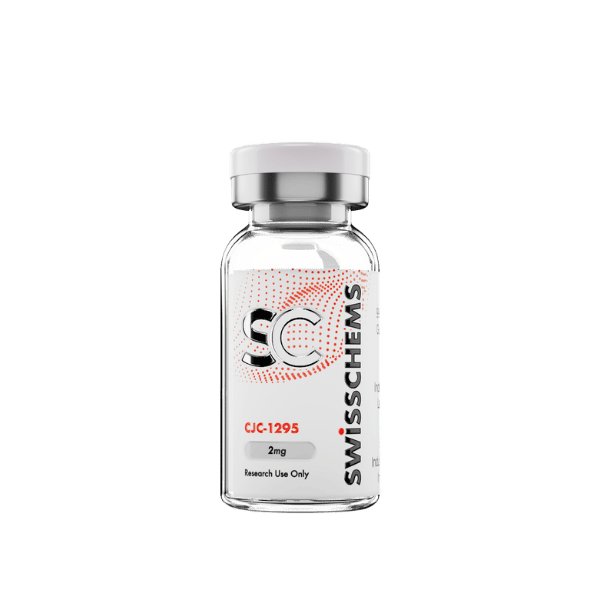
CJC-1295 without DAC 2 mg
Während der Umstellung unserer Verpackung erhalten Sie möglicherweise Produkte mit dem bisherigen oder dem neuen Etikett. Formulierung, Reinheit und Qualität bleiben nach unseren Standards genau gleich.
- Kreditkarte
- Banküberweisung (SEPA Echtzeit)
- Banküberweisung (ACH)
- Wise
- Revolut
- Zelle
- Remitly
- Western Union
- Chime
- Andere
-25% auf alles – bis 31. Oktober
25% auf reguläre Preise statt anderer Angebote. Nur mit dem Krypto-Zahlungsrabatt kombinierbar.
Jede Charge wird auf Reinheit, Wirksamkeit und Qualität geprüft.
Laborergebnisse ansehen →CJC-1295 without DAC is a synthetic 30-amino acid peptide analogue studied for its interactions with GHRH receptor pathways in experimental models. Also referred to as Modified GRF(1-29), the compound incorporates amino acid substitutions that confer enhanced protease resistance relative to native GHRH(1-29) while retaining GHRH receptor binding affinity.
Unlike the DAC-modified variant, CJC-1295 without DAC lacks the albumin-binding moiety, producing a shorter stability window in experimental systems that is studied for its utility in research protocols modelling pulsatile growth hormone secretagogue signalling.
Research applications include GHRH receptor pathway studies, pulsatile growth hormone signalling research, and comparative DAC versus non-DAC peptide pharmacology.
- High Purity – 99% Purity Guaranteed
- Independently Lab Tested
- Research Grade Quality
- For Laboratory Research Use Only
3D Molecular Structure
Drag to rotate · scroll to zoom| Chemical Formula | C152H252N44O42 |
|---|---|
| Synonyms | Modified GRF 1-29, Mod GRF 1-29, CJC-1295 no DAC |
| Molar Mass | 3367.9 g/mol |
| CAS Number | 446262-90-4 |
| PubChem CID | 91976842 |
| Total Compound Content | 2mg per vial |
| Shelf Life | 36 months |
Results refer to the tested sample. Check the batch and date in the report.
What distinguishes CJC-1295 without DAC from CJC-1295 with DAC in GHRH research models?
CJC-1295 without DAC lacks the maleimidopropionyl-lysine Drug Affinity Complex modification present in the DAC variant, meaning it does not engage albumin-binding mechanisms that extend peptide stability in biological research systems. This results in a shorter stability window studied for its utility in experimental protocols modelling pulsatile growth hormone secretagogue signalling, which more closely approximates endogenous GHRH release patterns, in contrast to the sustained signalling profile associated with the DAC-modified variant.
Why is CJC-1295 without DAC also referred to as Modified GRF(1-29) in research literature?
CJC-1295 without DAC is structurally equivalent to Modified GRF(1-29) — a tetrasubstituted analogue of the native GHRH(1-29) sequence incorporating D-Ala2, Gln8, Ala15, and Leu27 substitutions for enhanced protease resistance. The naming distinction in research literature reflects historical convention: 'CJC-1295' strictly denotes the DAC-modified form, while 'CJC-1295 without DAC' and 'Modified GRF(1-29)' both describe the unmodified tetrasubstituted sequence without the albumin-binding moiety.
How does the single vial format compare to the 10-vial KIT format for experimental protocol planning?
The single 2mg vial is suited to pilot studies, individual experimental runs, or protocols requiring a defined single-dose quantity, while the 10-vial KIT format supports larger research programs requiring multiple independent experimental replicates or extended timelines with consistent inter-vial compound quality. Researchers select format based on the total peptide quantity needed across all experimental arms and storage requirements for unused compound.