Verwendung: Dieses Produkt ist ausschließlich für Forschungszwecke bestimmt.
Alle Produktinformationen auf dieser Website dienen ausschließlich Bildungszwecken. Jede Form der Einbringung in den Körper von Menschen oder Tieren ist gesetzlich streng verboten. Dieses Produkt darf nur von zugelassenen und qualifizierten Fachleuten gehandhabt werden. Es ist kein Arzneimittel, Lebensmittel oder Kosmetikum und darf nicht als solches gekennzeichnet, verwendet oder falsch etikettiert werden.
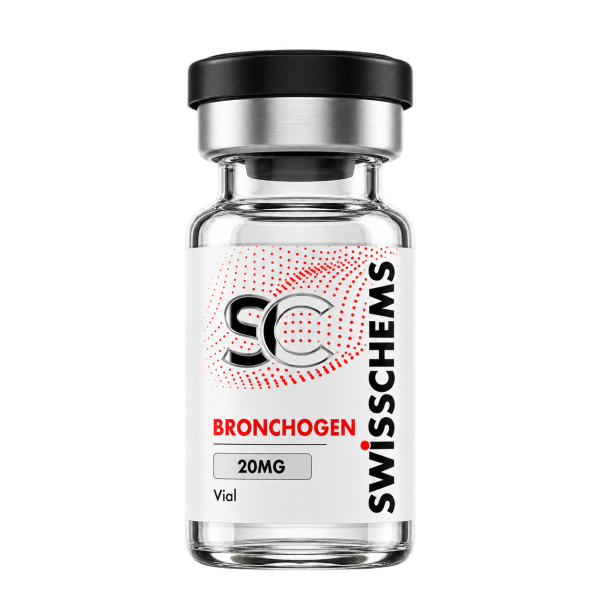
Bronchogen, 20mg
Während der Umstellung unserer Verpackung erhalten Sie möglicherweise Produkte mit dem bisherigen oder dem neuen Etikett. Formulierung, Reinheit und Qualität bleiben nach unseren Standards genau gleich.
- Kreditkarte
- Banküberweisung (SEPA Echtzeit)
- Banküberweisung (ACH)
- Wise
- Revolut
- Zelle
- Remitly
- Western Union
- Chime
- Andere
-25% auf alles – bis 31. Oktober
25% auf reguläre Preise statt anderer Angebote. Nur mit dem Krypto-Zahlungsrabatt kombinierbar.
Jede Charge wird auf Reinheit, Wirksamkeit und Qualität geprüft.
Laborergebnisse ansehen →Bronchogen is a synthetic bioregulatory peptide investigated for its activity in pulmonary tissue models. Research interest centers on its proposed influence on transcriptional regulation associated with inflammatory signalling, epithelial cell maintenance, and surfactant-related pathways.
Experimental studies have examined its effects on tissue-specific gene expression, cellular homeostasis, and signalling networks involved in pulmonary tissue function. Research applications include pulmonary bioregulator studies, epithelial signalling research, transcription pathway investigation, and comparative bioregulatory peptide pharmacology.
- High Purity – 99% Purity Guaranteed
- Independently Lab Tested
- Research Grade Quality
- For Laboratory Research Use Only
3D Molecular Structure
Drag to rotate · scroll to zoom| Chemical Formula | C18H30N4O9 |
|---|---|
| Molar Mass | 446.45 g/mol |
| Pubchem CID | 471572 |
| Total Compound Content | 20mg per vial |
| Shelf Life | 36 months |
Results refer to the tested sample. Check the batch and date in the report.
What pulmonary tissue models are used to study Bronchogen's effects on epithelial maintenance?
Research commonly utilizes bronchial and airway epithelial cell culture models to investigate Bronchogen's effects on epithelial maintenance, barrier integrity, cellular homeostasis, and proliferation-associated pathways. Ex vivo pulmonary tissue cultures are also used to examine tissue-specific responses while preserving native cellular architecture and signalling interactions.
How is Bronchogen's proposed influence on surfactant-related pathways investigated?
Experimental studies frequently employ alveolar epithelial cell models to evaluate surfactant-associated gene expression, protein synthesis, and secretion-related pathways. Common endpoints include measurement of surfactant-related biomarkers, transcriptional activity, and pathway-specific molecular responses following compound exposure.
What research models are used to investigate Bronchogen's role in pulmonary aging and senescence pathways?
Studies examining pulmonary senescence pathways typically utilize aged rodent models and cellular senescence systems to assess biomarkers such as p16INK4a, p21, and senescence-associated β-galactosidase activity. These molecular endpoints are often paired with histological assessment and tissue-architecture analysis to characterize changes in cellular homeostasis and senescence-associated signalling networks.