Verwendung: Dieses Produkt ist ausschließlich für Forschungszwecke bestimmt.
Alle Produktinformationen auf dieser Website dienen ausschließlich Bildungszwecken. Jede Form der Einbringung in den Körper von Menschen oder Tieren ist gesetzlich streng verboten. Dieses Produkt darf nur von zugelassenen und qualifizierten Fachleuten gehandhabt werden. Es ist kein Arzneimittel, Lebensmittel oder Kosmetikum und darf nicht als solches gekennzeichnet, verwendet oder falsch etikettiert werden.
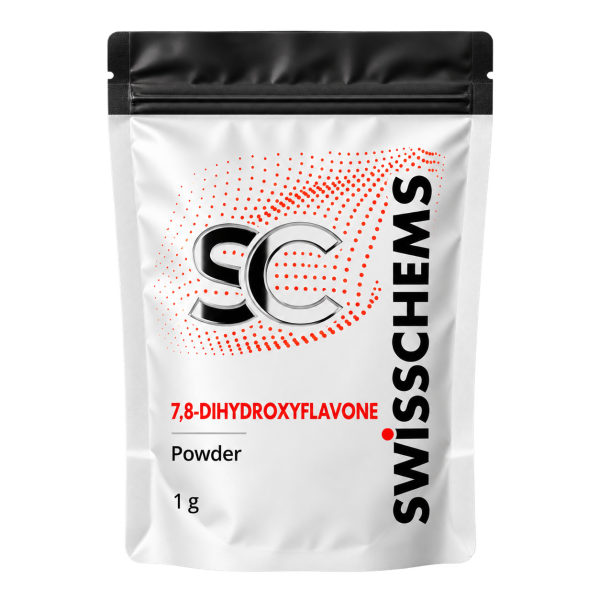
7,8-Dihydroxyflavone – Powder, 1 gram
Während der Umstellung unserer Verpackung erhalten Sie möglicherweise Produkte mit dem bisherigen oder dem neuen Etikett. Formulierung, Reinheit und Qualität bleiben nach unseren Standards genau gleich.
- Kreditkarte
- Banküberweisung (SEPA Echtzeit)
- Banküberweisung (ACH)
- Wise
- Revolut
- Zelle
- Remitly
- Western Union
- Chime
- Andere
-25% auf alles – bis 31. Oktober
25% auf reguläre Preise statt anderer Angebote. Nur mit dem Krypto-Zahlungsrabatt kombinierbar.
Jede Charge wird auf Reinheit, Wirksamkeit und Qualität geprüft.
Laborergebnisse ansehen →7,8-Dihydroxyflavone (7,8-DHF) is a flavonoid compound studied for specific molecular pathway interactions in experimental models, with laboratory research indicating selective TrkB receptor modulation properties. Research interest centers on its proposed role as a tool compound for investigating TrkB receptor-mediated signalling distinct from peptide-based neurotrophic factor research.
This powder format supports custom solution preparation for in vitro and in vivo research protocols. Research applications include TrkB receptor pharmacology, comparative flavonoid receptor-modulator studies, and small-molecule neurotrophic signalling research.
- High Purity – 99% Purity Guaranteed
- Independently Lab Tested
- Research Grade Quality
- For Laboratory Research Use Only
3D Molecular Structure
Drag to rotate · scroll to zoom| Chemical Formula | C15H10O4 |
|---|---|
| Synonyms | ADB6MA8ZV2, CHEMBL75267, Spectrum_001087, Spectrum2_000952, Spectrum3_000213 |
| Molar Mass | 254.24 g/mol |
| CAS Number | 38183-03-08 |
| PubChem CID | 1880 |
| Total Compound Content | 1 gram |
| Shelf Life | 36 months |
Every batch is independently lab tested for identity, purity and potency. View our lab testing program →
What solvents are typically used to prepare 7,8-Dihydroxyflavone powder for cell-based research applications?
DMSO is the standard solvent for preparing concentrated stock solutions of 7,8-Dihydroxyflavone given its limited aqueous solubility, with researchers typically diluting stock solutions into cell culture media or assay buffer immediately before use. Final DMSO concentration in experimental wells is generally kept low (well under 1%) to avoid solvent-related confounds on the cellular model under study.
How does 7,8-Dihydroxyflavone's small-molecule structure compare to peptide-based TrkB pathway research tools?
As a small-molecule flavonoid, 7,8-Dihydroxyflavone offers researchers a chemically stable alternative to peptide-based neurotrophic factor research tools, which often face stability and blood-brain barrier penetration limitations in experimental design. Comparative research examining both compound classes at the TrkB receptor allows investigators to characterise whether observed signalling outcomes depend on receptor engagement mechanism or are specific to one structural class of research tool.
What receptor-binding assays are used to characterise 7,8-Dihydroxyflavone's TrkB selectivity profile?
Radioligand displacement assays and surface plasmon resonance are standard methods for quantifying 7,8-Dihydroxyflavone's binding affinity at the TrkB receptor, typically run alongside parallel assays at related receptor tyrosine kinases (such as TrkA or TrkC) to establish selectivity. These binding data are usually paired with cell-based functional assays measuring downstream receptor autophosphorylation to confirm that binding translates to receptor activation in the specific experimental model under study.