Uso del prodotto: Questo prodotto è destinato esclusivamente alla ricerca.
Tutte le informazioni sui prodotti presenti su questo sito hanno scopo esclusivamente educativo. Qualsiasi forma di introduzione nel corpo di esseri umani o animali è severamente vietata dalla legge. Questo prodotto deve essere maneggiato solo da professionisti abilitati e qualificati. Non è un farmaco, un alimento o un cosmetico e non deve essere etichettato, utilizzato o presentato come tale.
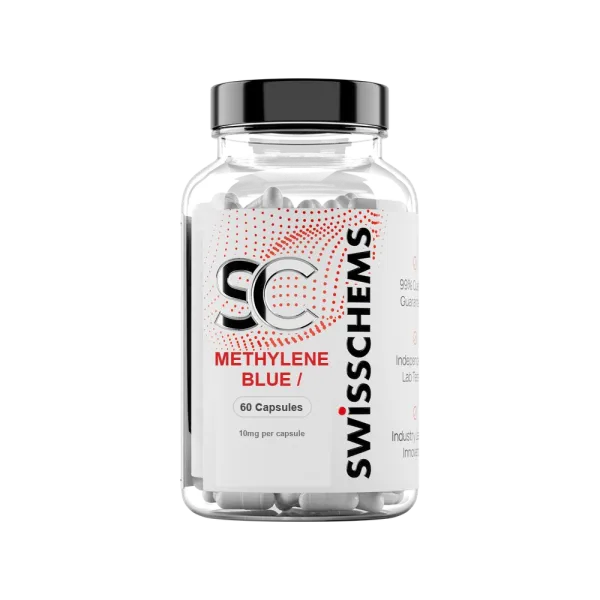
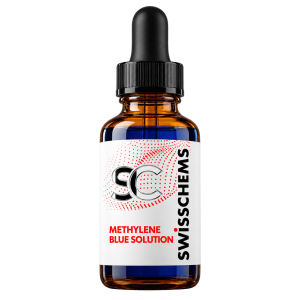
Methylene Blue 10mg/60caps
Durante il cambio di confezione potresti ricevere prodotti con l’etichetta precedente o con quella nuova. Formulazione, purezza e qualità restano esattamente le stesse, secondo i nostri standard.
- Carta di credito
- Bonifico bancario (SEPA istantaneo)
- Bonifico bancario (ACH)
- Wise
- Revolut
- Zelle
- Remitly
- Western Union
- Chime
- Altri metodi
-25% su tutto – fino al 31 Ottobre
25% sui prezzi ordinari, in sostituzione degli altri saldi. Cumulabile solo con lo sconto crypto.
Spedizione in giornata per gli ordini USA effettuati entro le 12:00 EST.
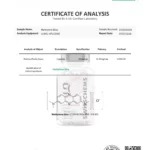
Vedi le condizioni di spedizione →Ogni lotto è testato per purezza, potenza e qualità.
Vedi i risultati di laboratorio →Methylene Blue is a heterocyclic aromatic chemical compound functioning as a redox indicator in research applications. The compound demonstrates selective inhibition of guanylate cyclase and modulation of nitric oxide-dependent pathways in experimental models. Methylene Blue exhibits electron transfer properties in oxidation-reduction reactions and serves as a photosensitizer in chemical analysis.
- High Purity – 99% Purity Guaranteed
- Independently Lab Tested
- Research Grade Quality
- For Laboratory Research Use Only
3D Molecular Structure
Drag to rotate · scroll to zoom| Chemical Formula | C16H18ClN3S |
|---|---|
| Synonyms | Methylthioninium chloride, 3,7-Bis(dimethylamino)phenothiazin-5-ium chloride |
| Molar Mass | 319.85 g/mol |
| CAS Number | 61-73-4 |
| PubChem CID | 6099 |
| Total Compound Content | 600 mg (10 mg per capsule) |
| Shelf Life | 36 months |
Results refer to the tested sample. Check the batch and date in the report.
How does Methylene Blue participate in electron transfer processes?
Methylene Blue possesses a reduction potential of approximately +11 mV and can reversibly cycle between oxidized and reduced states. This redox behavior enables participation in electron transfer reactions involving NADH/NADPH-dependent systems, cytochrome-associated pathways, and mitochondrial electron transport-related processes.
These characteristics have made Methylene Blue a valuable research tool for investigating electron transport dynamics, oxidation-reduction mechanisms, and redox-regulated signaling networks.
What interactions have been reported between Methylene Blue and protein aggregation systems?
Experimental investigations have examined interactions between Methylene Blue and protein aggregation pathways, including studies of protein assembly dynamics, intermolecular association processes, and aggregation-related structural transitions. Its well-characterized molecular properties have established Methylene Blue as a useful compound for investigating aggregation mechanisms, protein interaction networks, and the physicochemical factors influencing protein organization.
Why is Methylene Blue widely used in redox chemistry research?
Methylene Blue combines well-defined electron transfer properties, reversible redox cycling, and established photochemical characteristics within a single molecular scaffold. These features have made it a widely utilized reference compound for studies involving redox signaling, electron transport mechanisms, oxidation-reduction reactions, photochemical processes, phenothiazine pharmacology, and molecular pathway characterization associated with redox-active compounds.