Uso del prodotto: Questo prodotto è destinato esclusivamente alla ricerca.
Tutte le informazioni sui prodotti presenti su questo sito hanno scopo esclusivamente educativo. Qualsiasi forma di introduzione nel corpo di esseri umani o animali è severamente vietata dalla legge. Questo prodotto deve essere maneggiato solo da professionisti abilitati e qualificati. Non è un farmaco, un alimento o un cosmetico e non deve essere etichettato, utilizzato o presentato come tale.
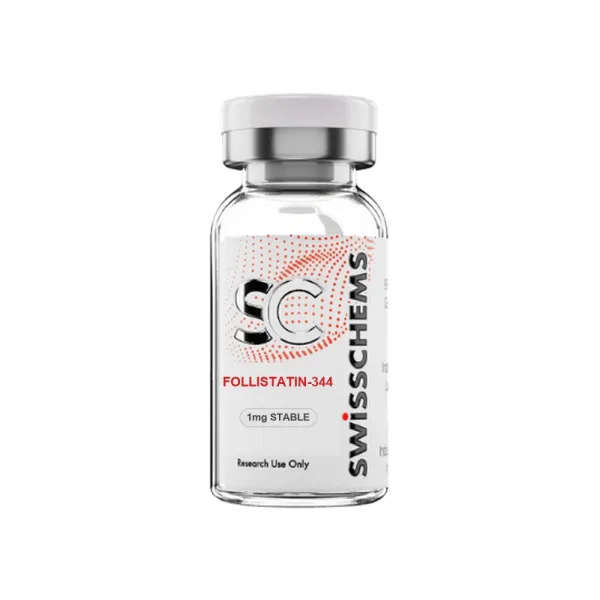
Follistatin-344 1mg
Durante il cambio di confezione potresti ricevere prodotti con l’etichetta precedente o con quella nuova. Formulazione, purezza e qualità restano esattamente le stesse, secondo i nostri standard.
- Carta di credito
- Bonifico bancario (SEPA istantaneo)
- Bonifico bancario (ACH)
- Wise
- Revolut
- Zelle
- Remitly
- Western Union
- Chime
- Altri metodi
-25% su tutto – fino al 31 Ottobre
25% sui prezzi ordinari, in sostituzione degli altri saldi. Cumulabile solo con lo sconto crypto.
Spedizione in giornata per gli ordini USA effettuati entro le 12:00 EST.
Vedi le condizioni di spedizione →Ogni lotto è testato per purezza, potenza e qualità.
Vedi i risultati di laboratorio →Follistatin-344 (FS-344) is the predominant isoform of follistatin, an endogenous glycoprotein that functions as a high-affinity binding protein for multiple members of the TGF-β superfamily. By sequestering ligands including activins, myostatin (GDF-8), and selected bone morphogenetic proteins (BMPs), Follistatin-344 prevents receptor engagement and downstream Smad-dependent signal transduction.
Experimental studies have utilized FS-344 to investigate activin receptor signaling, myostatin-associated regulatory pathways, TGF-β superfamily biology, ligand-receptor interaction dynamics, and Smad2/3- and Smad1/5/8-mediated transcriptional regulation.
Its broad ligand-binding profile and well-characterized mechanism make Follistatin-344 a valuable research tool for studies of growth factor signaling networks, extracellular ligand sequestration, pathway cross-talk within the TGF-β superfamily, and comparative investigations of myostatin and activin antagonism.
- High Purity – 99% Purity Guaranteed
- Independently Lab Tested
- Research Grade Quality
- For Laboratory Research Use Only
| Chemical Formula | C203H317N55O64S1 |
|---|---|
| Synonyms | Follistatin FST-344, FS-344, Activin-binding protein |
| Molar Mass | ~35,000 g/mol |
| CAS Number | 100043-71-8 |
| PubChem CID | N/A |
| Total Compound Content | 1 mg per vial |
| Shelf Life | 36 months |
Every batch is independently lab tested for identity, purity and potency. View our lab testing program →
What is the difference between Follistatin-344 and Follistatin-315, and why does isoform matter for research?
Follistatin-344 (FS-344) and Follistatin-315 (FS-315) are alternative splice variants of the FST gene that differ in their C-terminal sequence composition. FS-344 contains an additional peptide region associated with interactions involving heparan sulfate-containing structures, influencing its localization and distribution characteristics.
FS-315 lacks this extension and displays different extracellular distribution properties. These structural differences make isoform selection an important consideration in studies investigating ligand sequestration dynamics, TGF-β superfamily signaling, extracellular protein interactions, and growth factor distribution mechanisms.
Which TGF-β superfamily members does follistatin antagonize, and how selective is this interaction?
Follistatin functions as a broad-spectrum extracellular binding protein for multiple TGF-β superfamily ligands. Its highest-affinity interactions occur with activin family members, while additional binding activity has been documented for myostatin (GDF-8) and selected bone morphogenetic proteins (BMPs).
Because follistatin interacts with several ligand families rather than a single target, it is widely used in studies examining activin signaling, myostatin biology, BMP-associated pathways, receptor-ligand competition, and cross-talk within TGF-β superfamily signaling networks.
What experimental evidence supports follistatin's role in TGF-β superfamily signaling regulation?
Extensive experimental research has demonstrated that follistatin modulates TGF-β superfamily signaling through direct ligand sequestration, preventing receptor engagement and downstream Smad-dependent signal transduction.
Studies utilizing recombinant protein administration, transgenic expression systems, gene-transfer approaches, and in vitro signaling models have consistently shown suppression of activin-, myostatin-, and BMP-associated signaling pathways.
These findings have established follistatin as a widely used research tool for investigating extracellular growth factor regulation, ligand-neutralization mechanisms, Smad signaling networks, and TGF-β superfamily pathway biology.