Uso del prodotto: Questo prodotto è destinato esclusivamente alla ricerca.
Tutte le informazioni sui prodotti presenti su questo sito hanno scopo esclusivamente educativo. Qualsiasi forma di introduzione nel corpo di esseri umani o animali è severamente vietata dalla legge. Questo prodotto deve essere maneggiato solo da professionisti abilitati e qualificati. Non è un farmaco, un alimento o un cosmetico e non deve essere etichettato, utilizzato o presentato come tale.
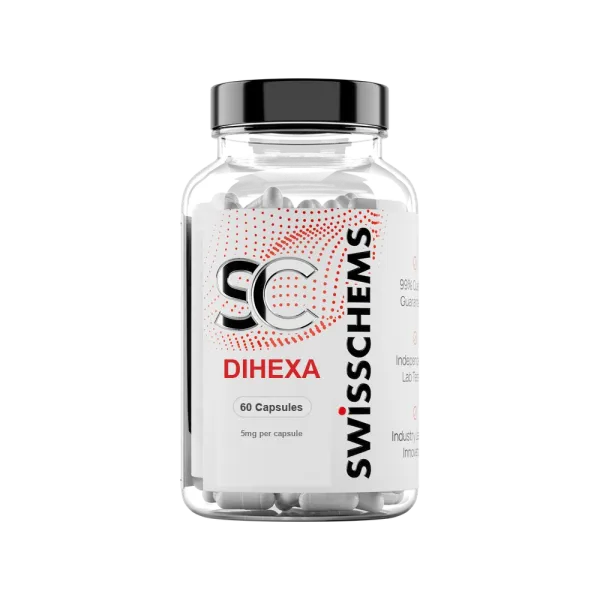
Dihexa (5mg/capsule), 60 Capsules
Durante il cambio di confezione potresti ricevere prodotti con l’etichetta precedente o con quella nuova. Formulazione, purezza e qualità restano esattamente le stesse, secondo i nostri standard.
- Carta di credito
- Bonifico bancario (SEPA istantaneo)
- Bonifico bancario (ACH)
- Wise
- Revolut
- Zelle
- Remitly
- Western Union
- Chime
- Altri metodi
-25% su tutto – fino al 31 Ottobre
25% sui prezzi ordinari, in sostituzione degli altri saldi. Cumulabile solo con lo sconto crypto.
Spedizione in giornata per gli ordini USA effettuati entro le 12:00 EST.
Vedi le condizioni di spedizione →Ogni lotto è testato per purezza, potenza e qualità.
Vedi i risultati di laboratorio →Dihexa (PNB-0408) is a synthetic compound derived from angiotensin IV, studied for its proposed interactions with hepatocyte growth factor (HGF) signalling and MET receptor pathway modulation in experimental models.
Research interest centers on the compound's proposed capacity to potentiate HGF activity at the MET receptor, with particular attention to downstream effects on synaptic density and cognitive function-related signalling in neurological research models. The capsule format provides a convenient, pre-measured delivery vehicle for oral administration research protocols.
Research applications include HGF/MET receptor pathway studies, synaptic signalling research, and comparative angiotensin analogue pharmacology.
Also available as Dihexa powder, 500mg. Other compounds in our Nootropics range: Noopept (Omberacetam) at 30mg/capsule and Semax 30mg.
- High Purity – 99% Purity Guaranteed
- Independently Lab Tested
- Research Grade Quality
- For Laboratory Research Use Only
3D Molecular Structure
Drag to rotate · scroll to zoom| Chemical Formula | C27H44N4O5 |
|---|---|
| Synonyms | PNB-0408, N-hexanoic-Tyr-Ile-(6) aminohexanoic amide, Dihexa (PNB-0408) |
| Molar Mass | 508.66 g/mol |
| CAS Number | 1401708-83-5 |
| PubChem CID | 129010512 |
| Total Compound Content | 300mg (5mg per capsule) |
| Shelf Life | 36 months |
Results refer to the tested sample. Check the batch and date in the report.
What is Dihexa's proposed mechanism of action at the HGF/MET receptor pathway?
Dihexa is studied for its proposed capacity to function as a potentiator of hepatocyte growth factor (HGF) at the MET receptor tyrosine kinase, rather than acting as a direct receptor agonist. Research models examine whether Dihexa binding stabilises HGF-MET receptor interactions or enhances receptor dimerisation, leading to amplified downstream signalling through pathways relevant to synaptic density and neuronal connectivity research.
How does the capsule format compare to the powder format for Dihexa research protocols?
The capsule format (5mg per capsule, 60 capsules) provides pre-measured, consistent dosing units suited to oral administration research protocols, while the powder format supports custom solution preparation for in vitro, parenteral, or variable-dose experimental designs. Researchers select format based on route of administration requirements and whether the protocol calls for fixed or variable dosing across experimental arms.
What experimental models are used to study Dihexa's proposed effects on synaptic signalling?
Primary hippocampal neuron cultures are used to study Dihexa's proposed effects on dendritic spine density and synaptic protein expression, typically measuring morphological changes via fluorescence microscopy and quantifying synaptic marker expression (such as PSD-95 or synaptophysin) relative to untreated controls. Rodent behavioural paradigms (such as Morris water maze or novel object recognition) provide complementary in vivo endpoints for studying cognitive function-related signalling research questions.