Uso del prodotto: Questo prodotto è destinato esclusivamente alla ricerca.
Tutte le informazioni sui prodotti presenti su questo sito hanno scopo esclusivamente educativo. Qualsiasi forma di introduzione nel corpo di esseri umani o animali è severamente vietata dalla legge. Questo prodotto deve essere maneggiato solo da professionisti abilitati e qualificati. Non è un farmaco, un alimento o un cosmetico e non deve essere etichettato, utilizzato o presentato come tale.
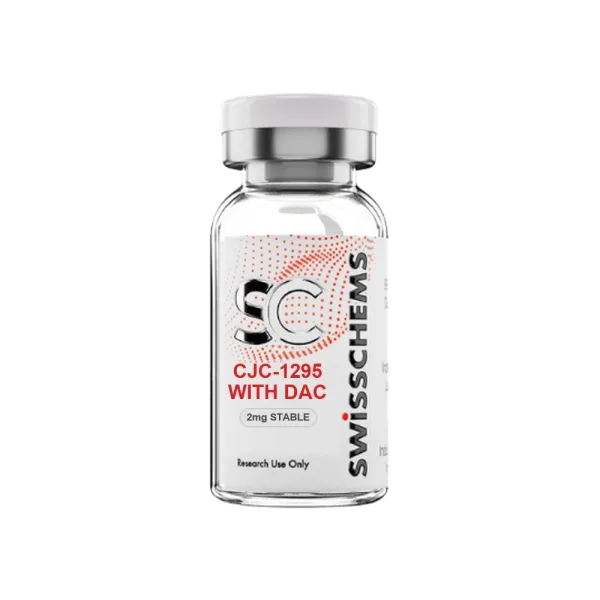
CJC-1295 with DAC, 2mg
Durante il cambio di confezione potresti ricevere prodotti con l’etichetta precedente o con quella nuova. Formulazione, purezza e qualità restano esattamente le stesse, secondo i nostri standard.
- Carta di credito
- Bonifico bancario (SEPA istantaneo)
- Bonifico bancario (ACH)
- Wise
- Revolut
- Zelle
- Remitly
- Western Union
- Chime
- Altri metodi
-25% su tutto – fino al 31 Ottobre
25% sui prezzi ordinari, in sostituzione degli altri saldi. Cumulabile solo con lo sconto crypto.
Spedizione in giornata per gli ordini USA effettuati entro le 12:00 EST.
Vedi le condizioni di spedizione →Ogni lotto è testato per purezza, potenza e qualità.
Vedi i risultati di laboratorio →CJC-1295 with DAC is a synthetic modified peptide compound studied for its interactions with growth hormone-releasing hormone (GHRH) receptor pathways in experimental models.
The Drug Affinity Complex (DAC) modification — a maleimidopropionyl-lysine moiety at the C-terminus — is studied for its capacity to reversibly bind albumin in experimental systems, producing extended stability compared to the unmodified CJC-1295 variant.
The compound is designed with a 30-amino acid sequence structure incorporating four amino acid substitutions that confer enhanced protease resistance relative to native GHRH(1-29). Research applications include GHRH receptor pathway studies, growth hormone secretagogue signalling research, and comparative DAC-modified versus unmodified peptide pharmacology.
- High Purity – 99% Purity Guaranteed
- Independently Lab Tested
- Research Grade Quality
- For Laboratory Research Use Only
3D Molecular Structure
Drag to rotate · scroll to zoom| Chemical Formula | C165H269N47O46 |
|---|---|
| Synonyms | CJC1295 With DAC, 446262-90-4 |
| Molar Mass | 3647.2 g/mol |
| CAS Number | 446262-90-4 |
| PubChem CID | 91971820 |
| Total Compound Content | 2mg per vial |
| Shelf Life | 36 months |
Every batch is independently lab tested for identity, purity and potency. View our lab testing program →
What is the Drug Affinity Complex (DAC) modification and how does it affect CJC-1295's stability in research models?
The DAC modification in CJC-1295 is a maleimidopropionyl-lysine moiety incorporated at the C-terminus of the peptide sequence, studied for its capacity to reversibly bind cysteine-34 of albumin in experimental systems. This albumin-binding interaction is studied for its role in significantly extending the peptide's stability in biological research models relative to the non-DAC CJC-1295 variant, making the DAC form a standard research tool in protocols requiring sustained receptor pathway engagement over extended experimental timelines.
How do the four amino acid substitutions in CJC-1295 differ from native GHRH(1-29)?
CJC-1295 incorporates D-Ala at position 2, Gln at position 8, Ala at position 15, and Leu at position 27 relative to native GHRH(1-29), substitutions studied for their capacity to confer enhanced resistance to proteolytic degradation while preserving GHRH receptor binding affinity. These modifications are examined in comparative structure-activity research contrasting CJC-1295's stability and receptor binding profile against native GHRH(1-29) and other GHRH analogues.
What advantages does the 10-vial KIT format provide for extended research programs?
The 10-vial KIT format is particularly useful for longitudinal investigations, repeated-dose studies, multi-arm experimental designs, pharmacokinetic research, and chronic pathway-signaling programs requiring consistent compound availability across multiple study phases.
Individually sealed vials allow compound to remain lyophilized until needed, supporting stability throughout extended research timelines. The use of matched-batch material across all ten vials also helps minimize variability between experimental sessions, making the KIT format well suited to long-duration receptor-signaling and comparative pharmacology studies.