Uso del prodotto: Questo prodotto è destinato esclusivamente alla ricerca.
Tutte le informazioni sui prodotti presenti su questo sito hanno scopo esclusivamente educativo. Qualsiasi forma di introduzione nel corpo di esseri umani o animali è severamente vietata dalla legge. Questo prodotto deve essere maneggiato solo da professionisti abilitati e qualificati. Non è un farmaco, un alimento o un cosmetico e non deve essere etichettato, utilizzato o presentato come tale.
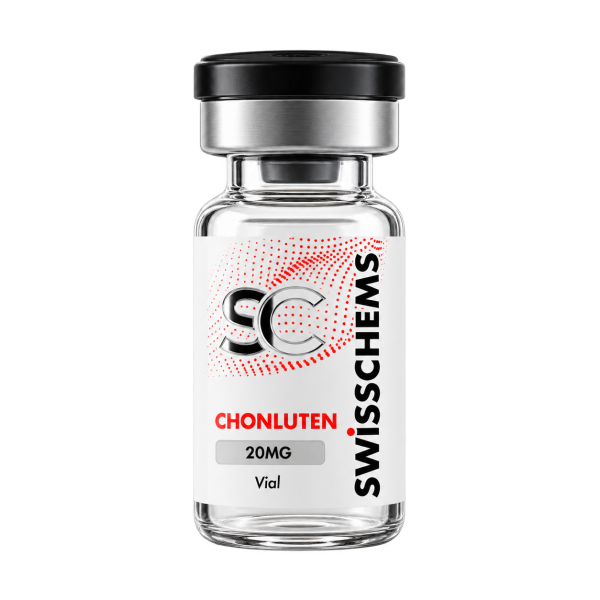
Chonluten, 20mg
Durante il cambio di confezione potresti ricevere prodotti con l’etichetta precedente o con quella nuova. Formulazione, purezza e qualità restano esattamente le stesse, secondo i nostri standard.
- Carta di credito
- Bonifico bancario (SEPA istantaneo)
- Bonifico bancario (ACH)
- Wise
- Revolut
- Zelle
- Remitly
- Western Union
- Chime
- Altri metodi
-25% su tutto – fino al 31 Ottobre
25% sui prezzi ordinari, in sostituzione degli altri saldi. Cumulabile solo con lo sconto crypto.
Spedizione in giornata per gli ordini USA effettuati entro le 12:00 EST.
Vedi le condizioni di spedizione →Ogni lotto è testato per purezza, potenza e qualità.
Vedi i risultati di laboratorio →Chonluten is a synthetic short peptide bioregulator studied for its role in modulating gene expression, with particular research interest in pulmonary tissue models.
Research interest centers on its proposed influence on genes involved in inflammatory signalling, antioxidant defense, and cell proliferation in response to tissue stress, with its highest observed research activity in lung tissue and secondary effects noted in gastrointestinal tract models.
Research applications include pulmonary gene expression studies, inflammatory pathway research, and comparative bioregulatory tripeptide pharmacology.
- High Purity – 99% Purity Guaranteed
- Independently Lab Tested
- Research Grade Quality
- For Laboratory Research Use Only
3D Molecular Structure
Drag to rotate · scroll to zoom| Chemical Formula | C11H17N3O8 |
|---|---|
| Synonyms | T-34 tripeptide, EDG |
| Molar Mass | 319.27 g/mol |
| CAS Number | 75007-24-8 |
| PubChem CID | 194641 |
| Total Compound Content | 20mg per vial |
| Shelf Life | 36 months |
Every batch is independently lab tested for identity, purity and potency. View our lab testing program →
What pulmonary tissue gene expression pathways are studied in connection with Chonluten exposure?
Lung epithelial and bronchial tissue models are used to study Chonluten's effects on gene expression panels related to inflammatory signalling (such as cytokine and chemokine gene expression), antioxidant defense mechanisms (such as glutathione pathway and superoxide dismutase gene expression), and cell proliferation markers, typically measured by qPCR or RNA-seq following compound exposure under baseline or stress-challenge conditions. Comparative analysis under tissue stress conditions (such as oxidant exposure) versus baseline allows researchers to characterise whether Chonluten's gene expression effects are stress-context-dependent.
How does Chonluten's secondary activity in gastrointestinal tract models relate to its primary pulmonary research focus?
Gastrointestinal mucosal tissue models, including intestinal epithelial cell cultures, are used to study Chonluten's secondary reported effects on mucosal function and tissue-stress-related gene expression, applying similar experimental approaches (gene expression panels, mucosal barrier integrity assays) used in the primary pulmonary research context. Comparative research across these two tissue systems allows investigation into whether Chonluten's mechanism reflects a tissue-general gene expression modulation pathway or distinct tissue-specific regulatory programs.
What experimental stress-challenge models are used to study Chonluten's effects on inflammatory pathway regulation?
Cell culture and ex vivo tissue models subjected to a defined inflammatory or oxidative stress challenge (such as LPS exposure for inflammatory pathway activation, or hydrogen peroxide exposure for oxidative stress) are standard systems for studying Chonluten's modulatory effects, with researchers comparing inflammatory marker expression and tissue damage readouts between stress-challenged tissue with and without Chonluten exposure. This stress-challenge experimental design allows characterisation of whether Chonluten's gene expression effects are most relevant under tissue-stress conditions rather than at baseline.