Uso del producto: Este producto está destinado exclusivamente a la investigación.
Toda la información de los productos de este sitio web tiene fines exclusivamente educativos. Cualquier forma de introducción en el cuerpo de personas o animales está estrictamente prohibida por la ley. Este producto solo debe ser manipulado por profesionales autorizados y cualificados. No es un medicamento, alimento ni cosmético y no debe etiquetarse, utilizarse ni presentarse como tal.
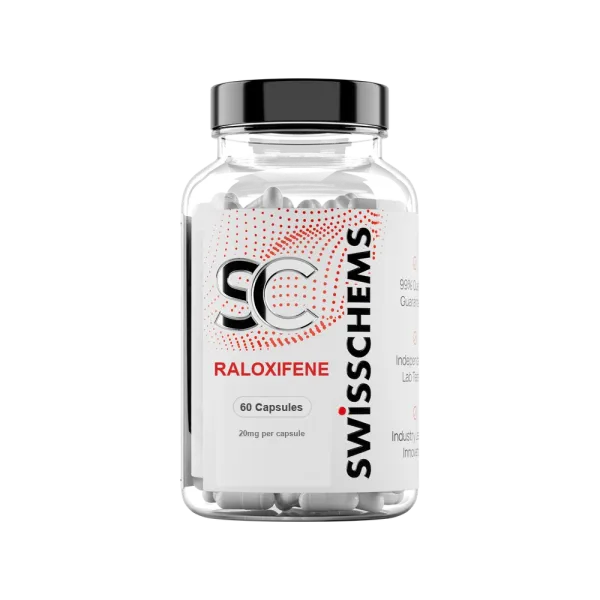
Raloxifene (20mg/capsule), 60 Capsules
Durante el cambio de envase, puedes recibir productos con la etiqueta anterior o con la nueva. La formulación, la pureza y la calidad siguen siendo exactamente las mismas, según nuestros estándares.
- Tarjeta de crédito
- Transferencia bancaria (SEPA inmediata)
- Transferencia bancaria (ACH)
- Wise
- Revolut
- Zelle
- Remitly
- Western Union
- Chime
- Otros
-25% en todo – hasta el 31 de octubre
25% sobre los precios habituales, en sustitución de otras ofertas. Acumulable solo con el descuento crypto.
Envío en el día para pedidos en EE. UU. realizados antes de las 12:00 EST.
Ver la política de envíos →Devoluciones sin complicaciones en 30 días para productos sin abrir.
Ver la política de devoluciones →Cada lote se analiza para comprobar su pureza, potencia y calidad.
Ver resultados de laboratorio →Raloxifene is a selective estrogen receptor modulator (SERM) that exhibits tissue-specific agonist and antagonist activity at estrogen receptors (ERs). It interacts with ERα and ERβ, influencing gene transcription and receptor-mediated signaling pathways.
This compound undergoes hepatic metabolism primarily via glucuronidation, producing inactive glucuronide conjugates.
- High Purity – 99% Purity Guaranteed
- Independently Lab Tested
- Research Grade Quality
- For Laboratory Research Use Only
3D Molecular Structure
Drag to rotate · scroll to zoom| Chemical Formula | C28H27NO4S |
|---|---|
| Synonyms | Keoxifene, LY156758 |
| Molar Mass | 473.58 g/mol |
| CAS Number | 84449-90-1 |
| PubChem CID | 5035 |
| Total Compound Content | 5 grams |
| Shelf Life | 36 months |
Results refer to the tested sample. Check the batch and date in the report.
What makes raloxifene's tissue selectivity distinct from tamoxifen's in receptor pharmacology research?
Both compounds bind the estrogen receptor, but the resulting receptor conformation differs in ways that alter coactivator/corepressor recruitment by tissue. Raloxifene's conformation favors antagonist activity in both breast and endometrial tissue, whereas tamoxifen retains partial agonist activity in the endometrium.
This divergence makes head-to-head SERM studies a common approach for mapping how structural differences in ligands translate into tissue-specific transcriptional outcomes.
How is raloxifene used in bone metabolism research models?
Because raloxifene's receptor conformation in bone tissue favors estrogen-agonist-like signaling, it is used in osteoblast/osteoclast culture models and in vivo bone density studies to examine estrogen-receptor-mediated effects on bone turnover, independent of the antagonist activity it shows in reproductive tissue.
What distinguishes raloxifene's metabolic pathway from other SERMs in pharmacokinetic research?
Raloxifene undergoes extensive glucuronidation rather than requiring CYP2D6-mediated bioactivation, unlike tamoxifen, which depends on CYP2D6 conversion to its active metabolite endoxifen. This makes raloxifene a useful comparator in research examining how metabolic activation requirements affect SERM activity and inter-individual variability tied to CYP2D6 polymorphisms.