
Uso del producto: Este producto está destinado exclusivamente a la investigación.
Toda la información de los productos de este sitio web tiene fines exclusivamente educativos. Cualquier forma de introducción en el cuerpo de personas o animales está estrictamente prohibida por la ley. Este producto solo debe ser manipulado por profesionales autorizados y cualificados. No es un medicamento, alimento ni cosmético y no debe etiquetarse, utilizarse ni presentarse como tal.
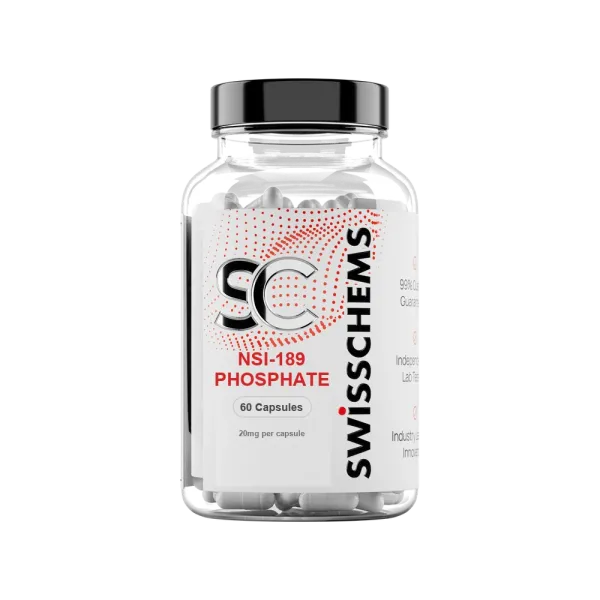
NSI-189 Phosphate (20mg/capsule), 60 Capsules
Durante el cambio de envase, puedes recibir productos con la etiqueta anterior o con la nueva. La formulación, la pureza y la calidad siguen siendo exactamente las mismas, según nuestros estándares.
- Tarjeta de crédito
- Transferencia bancaria (SEPA inmediata)
- Transferencia bancaria (ACH)
- Wise
- Revolut
- Zelle
- Remitly
- Western Union
- Chime
- Otros
-25% en todo – hasta el 31 de octubre
25% sobre los precios habituales, en sustitución de otras ofertas. Acumulable solo con el descuento crypto.
Envío en el día para pedidos en EE. UU. realizados antes de las 12:00 EST.
Ver la política de envíos →Devoluciones sin complicaciones en 30 días para productos sin abrir.
Ver la política de devoluciones →Cada lote se analiza para comprobar su pureza, potencia y calidad.
Ver resultados de laboratorio →NSI-189 phosphate is a synthetic benzylpiperazine-aminopyridine derivative investigated for its effects on neural progenitor cell biology and hippocampal neurogenesis pathways.
Unlike compounds that primarily modulate monoamine transporters or neurotransmitter receptors, NSI-189 has been studied for its reported ability to promote proliferation, differentiation, and survival of neural progenitor cells in experimental models.
Research has focused on its effects on hippocampal cell populations, neurogenic signalling pathways, neuronal maturation processes, and structural plasticity mechanisms.
Experimental applications include neural progenitor proliferation assays, neurogenesis pathway investigations, cell differentiation studies, hippocampal tissue modelling, and structure-activity relationship (SAR) research within the benzylpiperazine-aminopyridine compound class.
- High Purity – 99% Purity Guaranteed
- Independently Lab Tested
- Research Grade Quality
- For Laboratory Research Use Only
3D Molecular Structure
Drag to rotate · scroll to zoom| Chemical Formula | C22H33N4O5P |
|---|---|
| Synonyms | NSI-189 phosphate 1270138-41-4, UNII-HX0VO60T62, HX0VO60T62, NSI189 Phosphate |
| Molar Mass | 464.5 g/mol |
| CAS Number | 1270138-41-4 |
| PubChem CID | 50922680 |
| Total Compound Content | 1200mg (20mg per capsule) |
| Shelf Life | 36 months |
Results refer to the tested sample. Check the batch and date in the report.
What cell-based assays are used to characterize NSI-189 phosphate's effects on neural progenitor cells?
Common experimental approaches include in vitro proliferation assays using neural progenitor cell cultures, with proliferation quantified through markers such as BrdU incorporation or Ki-67 expression. Differentiation studies often monitor changes in neuronal lineage markers, including doublecortin (DCX) and NeuN, over extended culture periods.
Concentration-response experiments are frequently performed to characterize proliferative activity and compare responses across different experimental conditions.
How is neurogenesis quantified in experimental NSI-189 studies?
Neurogenesis research typically utilizes immunohistochemical analysis of proliferation markers such as Ki-67 and BrdU, together with immature neuronal markers including doublecortin (DCX). Quantification is commonly performed through stereological cell counting, image-based analysis, and biomarker expression profiling.
Additional assessments may include volumetric imaging and histological measurements to evaluate structural changes associated with prolonged experimental exposure.
What distinguishes NSI-189 phosphate from compounds acting through monoaminergic pathways?
NSI-189 phosphate is investigated primarily for its reported effects on progenitor-cell proliferation and neurogenesis-associated signalling pathways rather than direct interaction with monoamine transporters or neurotransmitter receptors.
Mechanistic studies often employ receptor antagonists or pathway-specific inhibitors to determine whether observed cellular effects persist independently of monoaminergic signalling. This approach helps distinguish progenitor-cell-directed activity from secondary effects associated with neurotransmitter-dependent mechanisms.