Uso del producto: Este producto está destinado exclusivamente a la investigación.
Toda la información de los productos de este sitio web tiene fines exclusivamente educativos. Cualquier forma de introducción en el cuerpo de personas o animales está estrictamente prohibida por la ley. Este producto solo debe ser manipulado por profesionales autorizados y cualificados. No es un medicamento, alimento ni cosmético y no debe etiquetarse, utilizarse ni presentarse como tal.
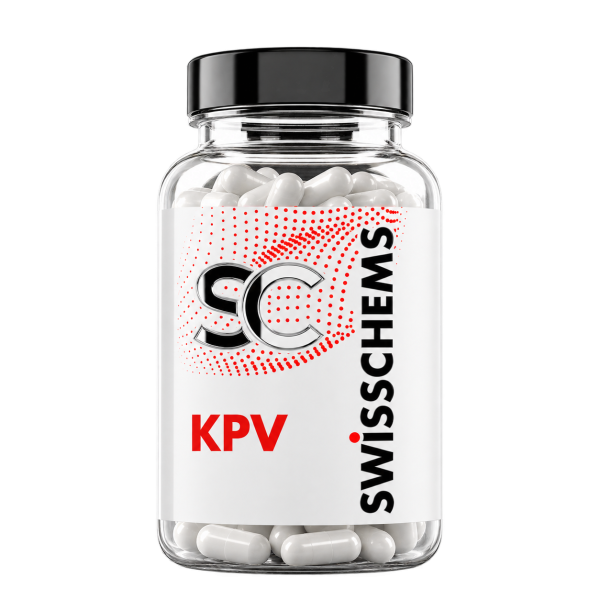
KPV (Lysine-Proline-Valine) 250mcg/60caps
Durante el cambio de envase, puedes recibir productos con la etiqueta anterior o con la nueva. La formulación, la pureza y la calidad siguen siendo exactamente las mismas, según nuestros estándares.
- Tarjeta de crédito
- Transferencia bancaria (SEPA inmediata)
- Transferencia bancaria (ACH)
- Wise
- Revolut
- Zelle
- Remitly
- Western Union
- Chime
- Otros
-25% en todo – hasta el 31 de octubre
25% sobre los precios habituales, en sustitución de otras ofertas. Acumulable solo con el descuento crypto.
Envío en el día para pedidos en EE. UU. realizados antes de las 12:00 EST.
Ver la política de envíos →Devoluciones sin complicaciones en 30 días para productos sin abrir.
Ver la política de devoluciones →Cada lote se analiza para comprobar su pureza, potencia y calidad.
Ver resultados de laboratorio →KPV (Lysine-Proline-Valine) is the C-terminal tripeptide fragment of alpha-melanocyte-stimulating hormone (alpha-MSH), corresponding to residues 11-13 and also present within the corresponding region of adrenocorticotropic hormone (ACTH).
Research interest centers on KPV's reported melanocortin receptor-independent activity in cell-based inflammatory signalling models, distinguishing it from full-length melanocortin receptor agonists. Research applications include melanocortin fragment structure-activity studies, NF-κB pathway investigation, and tripeptide stability/delivery research.
- High Purity – 99% Purity Guaranteed
- Independently Lab Tested
- Research Grade Quality
- For Laboratory Research Use Only
3D Molecular Structure
Drag to rotate · scroll to zoom| Chemical Formula | C16H30N4O4 |
|---|---|
| Synonyms | Lys-pro-val, L-Valine, N-(1-L-lysyl-L-prolyl)-, Msh (11-13), L-Lysyl-L-prolyl-L-valine, Lysyl-prolyl-valine, ACTH-(11-13) |
| Molar Mass | 342.43 g/mol |
| CAS Number | 67727-97-3 |
| PubChem CID | 125672 |
| Total Compound Content | 15mg (250mcg/capsule) |
| Shelf Life | 36 months |
Results refer to the tested sample. Check the batch and date in the report.
How does KPV's proposed mechanism differ from full-length alpha-MSH's melanocortin receptor activity?
Full-length alpha-MSH activates the canonical melanocortin receptors (primarily MC1R), a G protein-coupled receptor pathway producing cAMP-dependent downstream signalling.
KPV, as a minimal C-terminal tripeptide fragment, is investigated for effects in cell-based models (including NF-κB transcriptional readouts) that appear to occur with reduced dependence on classical MC1R-mediated signalling, making it a research tool for distinguishing melanocortin receptor-dependent from receptor-independent peptide activity.
Researchers studying this distinction typically use MC1R antagonists or receptor-knockout/knockdown models alongside KPV exposure to determine the receptor-dependence of observed effects.
What cell-based assays are used to study KPV's effects on NF-κB signaling?
Standard approaches include NF-κB-responsive luciferase reporter assays in cell lines stimulated with a pro-inflammatory trigger (such as LPS or TNF-α) with and without KPV co-treatment, alongside direct measurement of NF-κB nuclear translocation by immunofluorescence or Western blot of nuclear/cytoplasmic fractions. Downstream readouts often include quantification of NF-κB target gene products (pro-inflammatory cytokines, chemokines) by ELISA or qPCR to characterise the functional consequence of any observed transcriptional modulation.
Why is KPV used as a tool for studying the shared C-terminal sequence of alpha-MSH and ACTH?
Because the Lys-Pro-Val sequence is conserved in both alpha-MSH and ACTH at the same relative position, KPV serves as a minimal structural probe for research questions about which biological activities of these larger peptide hormones map to this specific C-terminal motif versus other regions of the parent sequence. Comparative studies using KPV alongside other fragments of alpha-MSH/ACTH (such as the N-terminal or central regions) allow researchers to build structure-activity maps of the full hormone sequence.