Uso del producto: Este producto está destinado exclusivamente a la investigación.
Toda la información de los productos de este sitio web tiene fines exclusivamente educativos. Cualquier forma de introducción en el cuerpo de personas o animales está estrictamente prohibida por la ley. Este producto solo debe ser manipulado por profesionales autorizados y cualificados. No es un medicamento, alimento ni cosmético y no debe etiquetarse, utilizarse ni presentarse como tal.
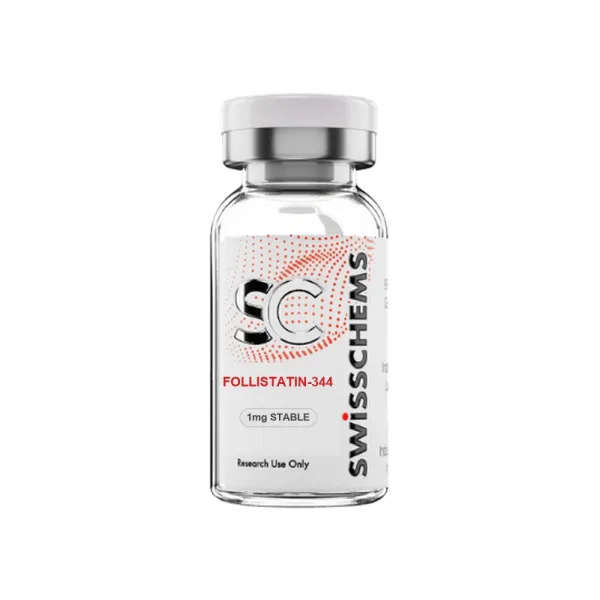
Follistatin-344 1mg
Durante el cambio de envase, puedes recibir productos con la etiqueta anterior o con la nueva. La formulación, la pureza y la calidad siguen siendo exactamente las mismas, según nuestros estándares.
- Tarjeta de crédito
- Transferencia bancaria (SEPA inmediata)
- Transferencia bancaria (ACH)
- Wise
- Revolut
- Zelle
- Remitly
- Western Union
- Chime
- Otros
-25% en todo – hasta el 31 de octubre
25% sobre los precios habituales, en sustitución de otras ofertas. Acumulable solo con el descuento crypto.
Envío en el día para pedidos en EE. UU. realizados antes de las 12:00 EST.
Ver la política de envíos →Devoluciones sin complicaciones en 30 días para productos sin abrir.
Ver la política de devoluciones →Cada lote se analiza para comprobar su pureza, potencia y calidad.
Ver resultados de laboratorio →Follistatin-344 (FS-344) is the predominant isoform of follistatin, an endogenous glycoprotein that functions as a high-affinity binding protein for multiple members of the TGF-β superfamily. By sequestering ligands including activins, myostatin (GDF-8), and selected bone morphogenetic proteins (BMPs), Follistatin-344 prevents receptor engagement and downstream Smad-dependent signal transduction.
Experimental studies have utilized FS-344 to investigate activin receptor signaling, myostatin-associated regulatory pathways, TGF-β superfamily biology, ligand-receptor interaction dynamics, and Smad2/3- and Smad1/5/8-mediated transcriptional regulation.
Its broad ligand-binding profile and well-characterized mechanism make Follistatin-344 a valuable research tool for studies of growth factor signaling networks, extracellular ligand sequestration, pathway cross-talk within the TGF-β superfamily, and comparative investigations of myostatin and activin antagonism.
- High Purity – 99% Purity Guaranteed
- Independently Lab Tested
- Research Grade Quality
- For Laboratory Research Use Only
| Chemical Formula | C203H317N55O64S1 |
|---|---|
| Synonyms | Follistatin FST-344, FS-344, Activin-binding protein |
| Molar Mass | ~35,000 g/mol |
| CAS Number | 100043-71-8 |
| PubChem CID | N/A |
| Total Compound Content | 1 mg per vial |
| Shelf Life | 36 months |
Every batch is independently lab tested for identity, purity and potency. View our lab testing program →
What is the difference between Follistatin-344 and Follistatin-315, and why does isoform matter for research?
Follistatin-344 (FS-344) and Follistatin-315 (FS-315) are alternative splice variants of the FST gene that differ in their C-terminal sequence composition. FS-344 contains an additional peptide region associated with interactions involving heparan sulfate-containing structures, influencing its localization and distribution characteristics.
FS-315 lacks this extension and displays different extracellular distribution properties. These structural differences make isoform selection an important consideration in studies investigating ligand sequestration dynamics, TGF-β superfamily signaling, extracellular protein interactions, and growth factor distribution mechanisms.
Which TGF-β superfamily members does follistatin antagonize, and how selective is this interaction?
Follistatin functions as a broad-spectrum extracellular binding protein for multiple TGF-β superfamily ligands. Its highest-affinity interactions occur with activin family members, while additional binding activity has been documented for myostatin (GDF-8) and selected bone morphogenetic proteins (BMPs).
Because follistatin interacts with several ligand families rather than a single target, it is widely used in studies examining activin signaling, myostatin biology, BMP-associated pathways, receptor-ligand competition, and cross-talk within TGF-β superfamily signaling networks.
What experimental evidence supports follistatin's role in TGF-β superfamily signaling regulation?
Extensive experimental research has demonstrated that follistatin modulates TGF-β superfamily signaling through direct ligand sequestration, preventing receptor engagement and downstream Smad-dependent signal transduction.
Studies utilizing recombinant protein administration, transgenic expression systems, gene-transfer approaches, and in vitro signaling models have consistently shown suppression of activin-, myostatin-, and BMP-associated signaling pathways.
These findings have established follistatin as a widely used research tool for investigating extracellular growth factor regulation, ligand-neutralization mechanisms, Smad signaling networks, and TGF-β superfamily pathway biology.