Uso del producto: Este producto está destinado exclusivamente a la investigación.
Toda la información de los productos de este sitio web tiene fines exclusivamente educativos. Cualquier forma de introducción en el cuerpo de personas o animales está estrictamente prohibida por la ley. Este producto solo debe ser manipulado por profesionales autorizados y cualificados. No es un medicamento, alimento ni cosmético y no debe etiquetarse, utilizarse ni presentarse como tal.
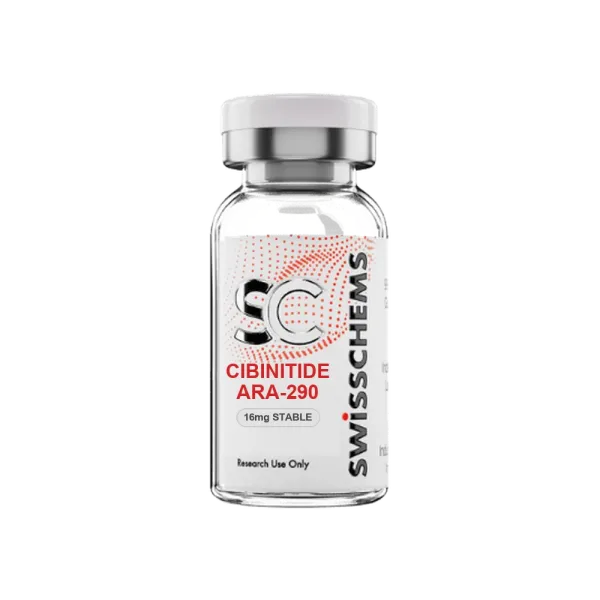
Cibinitide ARA-290 16mg
Durante el cambio de envase, puedes recibir productos con la etiqueta anterior o con la nueva. La formulación, la pureza y la calidad siguen siendo exactamente las mismas, según nuestros estándares.
- Tarjeta de crédito
- Transferencia bancaria (SEPA inmediata)
- Transferencia bancaria (ACH)
- Wise
- Revolut
- Zelle
- Remitly
- Western Union
- Chime
- Otros
-25% en todo – hasta el 31 de octubre
25% sobre los precios habituales, en sustitución de otras ofertas. Acumulable solo con el descuento crypto.
Envío en el día para pedidos en EE. UU. realizados antes de las 12:00 EST.
Ver la política de envíos →Devoluciones sin complicaciones en 30 días para productos sin abrir.
Ver la política de devoluciones →Cada lote se analiza para comprobar su pureza, potencia y calidad.
Ver resultados de laboratorio →Cibinitide (ARA-290) is a synthetic peptide engineered from a structural region of erythropoietin (EPO), designed to engage the innate repair receptor (IRR) — a heterodimeric receptor complex distinct from the classical homodimeric erythropoietin receptor responsible for erythropoiesis.
Research interest centers on its capacity to activate IRR-mediated signalling without the haematopoietic effects associated with full EPO receptor engagement. Research applications include innate repair receptor pathway studies, cytoprotective signalling research, and EPO-derived peptide structure-activity investigation.
- High Purity – 99% Purity Guaranteed
- Independently Lab Tested
- Research Grade Quality
- For Laboratory Research Use Only
3D Molecular Structure
Drag to rotate · scroll to zoom| Chemical Formula | C51H84N16O21 |
|---|---|
| Synonyms | Cibinetide, PH-BSP, ARA290 |
| Molar Mass | 1257.31 g/mol |
| CAS Number | 1208243-50-8 |
| PubChem CID | 91810664 |
| Total Compound Content | 160mg (16mg per 1 vial) |
| Shelf Life | 36 months |
Results refer to the tested sample. Check the batch and date in the report.
How does cibinitide's selectivity for the innate repair receptor distinguish it from native erythropoietin signaling?
Native erythropoietin activates the classical homodimeric EPO receptor to drive erythropoiesis (red blood cell production) in addition to other downstream effects.
Cibinitide was engineered to selectively engage the innate repair receptor (IRR) — a distinct heterodimeric complex of the EPO receptor and the common beta receptor subunit (CD131) — without activating the homodimeric EPO receptor pathway responsible for erythropoietic effects.
Research distinguishing these two signalling outcomes typically uses hematocrit or reticulocyte count as a readout for erythropoietic activity alongside IRR-specific signalling markers, to confirm selective IRR engagement without off-target erythropoietic stimulation.
What cell-based assays are used to study cibinitide's activation of innate repair receptor signaling?
Cell lines expressing the IRR complex (EPO receptor plus CD131) are used in receptor engagement and downstream signalling assays, typically measuring activation of JAK2/STAT5 or other cytoprotective signalling intermediates following cibinitide exposure, compared against cell lines expressing only the classical homodimeric EPO receptor to confirm receptor-complex-dependent selectivity. Inflammatory pathway readouts — such as NF-κB activation status or downstream cytokine production — are also used in models examining cibinitide's reported anti-inflammatory signalling effects.
What rodent injury models are used to study cibinitide's cytoprotective signaling effects?
Rodent models of tissue injury and inflammatory challenge — including peripheral nerve injury, ischemia-reperfusion injury models, and inflammatory pain models — have been used to study cibinitide's effects on cytoprotective and anti-inflammatory signalling pathways downstream of IRR activation. These studies typically combine behavioral or functional injury-recovery endpoints with tissue-level markers of inflammation and cell survival to characterise the peptide's pathway-specific effects in an intact physiological system.